Browsers noticed

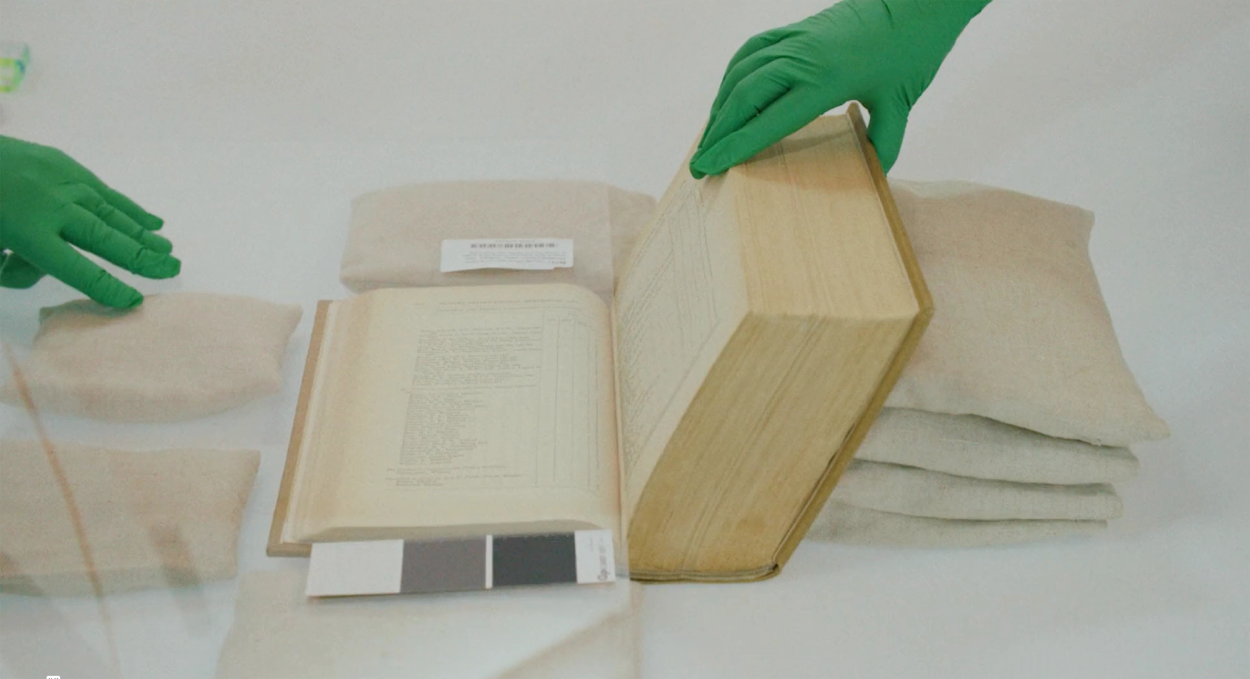
We are enjoying a feature of Koha that allows us to track invisible users. These are the people (internal and external) who consult material within the Library without needing to borrow. When they’ve finished reading, they leave the items on a trolley, ready for shelving by Library staff. Formerly, the items were simply replaced on the shelves.

Now though, we can capture that unobserved browsing. Before shelving we scan the barcodes of the used items to a statistical borrower. The addition of these statistics to our other circulation figures, gives us a more accurate picture of how the Library is being used. It’s especially satisfying to be able to quantify the enormous numbers of books, pamphlets and serials, not to mention the diverse subject areas called for by both internal and external clients. An excellent measuring tool.

Koha live today in the Research Library!

After two years of preparatory work, the Research Library staff are thrilled to announce the introduction of our fourth generation library system, Koha . Note the stylised kiwi in the top left hand corner. As a Kiwi myself, I’m proud to say that Koha hails from Aotearoa. ‘Koha’ means ‘gift from the heart’, which pretty well sums it up for us.

Using Koha, allows us even more interactivity with our internal and external clients. They can now:

• Do their own renewals and reserves online
• Save their search results to private and public lists
• Offer suggestions for purchase
• Contribute book reviews and cloud tags

We can now display our bibliographic records with book covers, as well as adding photos of users to their borrowing records. Live today in the Research Library, we hope to have our Koha OPAC available across the Powerhouse Museum, Sydney Observatory and Powerhouse Discovery Centre sites, and on the Museum’s website, by the end of this week. We’ll keep you posted. Meanwhile, watch this space!

J & OD students

March was a month for visitors. We had several groups of second and third year Jewellery and Object Design students students (36 in all) from the Design Centre Enmore.

They were led each time by their teacher, Danielle Butters. If she was bored at having to repeat the visits, she didn’t show it!

As with all group visits, we gave an introductory talk about the Research Library, the history of its collection and the way it contributes to exhibitions in the Museum. We then divided the class into smaller groups of 5 or 6 for a walkabout. To avoid tripping over each other, we started at different points in the Library, crossing over as the tour progressed. Jewellery students are great to show around. Their studies encompass so many subject areas that we delve into nearly every part of the Library. We rifle through books and journals on metalwork, jewellery design, costume, ornament, crafts, textile and fibre design, knitting patterns, architecture, photography, graphic design – everything, in fact, from decorative arts to technology, which is just what this Museum is all about.

The students spent time browsing the shelves until it was time go over to the Museum. Here, they toured the Benini exhibition before heading back to class.

Museum experiences

Over the past two weeks, the Library has been visited many times by science educator Dennis Schatz, who is undertaking research for a book about Australia’s history. Originally a solar astronomer, Dennis is now Senior Vice President in charge of strategic programs at the Pacific Science Center in Seattle, Washington. This is a science museum with a difference – it has no objects! Rather, it offers experiences in science, maths and technology through interactive exhibits and programs. What a terrific learning environment.

Dennis is the author of 21 science and astronomy books for children. He is also co-author/editor of several curriculum resources for teachers. Check out all his publications on his website . His current research is for a book about what it was like for Australian children growing up during the gold rush era in Ballarat c.1850, and for children & families on the home front during WWI.

In case you’re wondering, Dennis’s strong connection with Australia stems from a year he spent at Sydney Uni in 1970.

It’s that time of year again

Last Thursday, 16 students and a lecturer from Charles Sturt University called in.
Library & Information students from CSU spend two days at the end of each year in Sydney, touring libraries from a range of organisations, including the Powerhouse Museum. By the time Thursday’s group appeared, they’d already visited the respective libraries of the NSW Art Gallery, NSW Health Department, NSW State Archives, NSW Parliament, a law firm, and the ABC. Far from being jaded, as you might expect, they were keen to see how a museum library worked.
With group visits,we usually divide the participants between the three of us and, starting at different points in the library, give the grand tour, pointing out store and auction catalogues, new books and journals, vintage journals, sewing patterns, knitting patterns, trade literature etc This time was different, thanks to colleague Dimity Holt, who has hit upon the clever idea of referencing current exhibitions in the museum by spotlighting parts of the library collection. She used the Benini Exhibition to set up a thematic display of books about fashion photography, cameras, fashion photographers, fashion models, history of photography. This enabled the students to see clearly, the connection between the Library collection and what is on in the museum. We added further emphasis by finishing off the tour with a walk through of the fabulous Benini Exhibition.

22 of her own costumes on the dance floor!

This week I received a welcome email from a visitor, who used the Research Library in January. Margarita Martinez is a costume designer based in Florence, Italy. She designs and creates historical ball gowns and for over 20 years her costumes have danced in the most magnificent ballrooms in Tuscany…more from her website

In her email, Margarita told me about two remarkable events organised by her recently. They were held in Florence during the weekend of 22-23 May 2010. The first, on Saturday, was a Grand Napoleonic Ball held at Villa del Poggio Imperiale to honour the bicentenary of Napoleon’s sister, Elisa taking up residence there. Guests were requested to dress in Napoleonic Court dress. The dances, led by historical dance master Donald Francis, were accompanied by an orchestra led by Maestro James Gray. An Empire Buffet Froid Supper with dishes of the period was also served.

Sunday was Jane Austen Day at Villa Gerini, a grand family home set in classical gardens on the outskirts of Florence. Guests dressed in Regency attire for a relaxing day of promenading around the lake, playing croquet, cricket and quoits, before changing outfits for a Regency Ball in the evening.

One reenactor described the weekend to me: “…it was absolutely huge, people came from all over the world to attend. On the nights of the rehearsal and [Grand Napoleonic] Ball I spoke to people from Sweden, Norway, France, Spain, Czech republic, Hungary, Switzerland, England, Italy and America. The settings were beautiful, with the dance rehearsal being held in the ballroom of the Palazzo Borghese all green marble and gold chandeliers, and then the ball itself at Villa Poggi Imperiale with amazing frescoed apartments and a grand white ballroom with an enormous chandelier.”

Margarita had 22 of her own costumes on the dance floors!

You can see Phil Thomason’s wonderful photos of the Weekend here.

Fusion of fashion

Last Friday saw a visit from Australian fashion designer Kym Ellery and her production co-ordinator Rachel Sherwood. You can see some of Kym’s creations on her website. Ellery’s clothes are HOT. The Rosemount Australian Fashion Week 2010 website notes that Ellery is the “go-to label for Australian it-girls” and that her “effortlessly hip aesthetic is [seen as] fashion’s newest asset”.

Kym and Rachel came to the Research Library to source ideas for their Autumn-Winter collection of 2011. They are researching costume and adornment of the French Revolution, as well as knitwear and lace motifs. Using the characters from the 2001 movie “The Royal Tenenbaums” as base silhouettes, their new range will combine the film’s costumes and colour palettes with the costume styles of the French Revolution plus a soupçon of contemporary knitwear designs. Oh, and lace as well – magic!

Cameo appearance

Cameo

Photography by Antonella Schulte

Earlier this week, Antonella Schulte came to the Research Library to study cameos. Antonella is completing a masters degree at Sydney Uni. in Museum studies and as part of the course has to select an object from her own collection and write a formal proposal to a museum, offering the object as an acquisition. This means providing information about the object such as its description, history, provenance, statement of significance, why it would be right for a museum’s collection.

Her grandmother’s cameo had always been something of a curiosity in the family; no one knew where it came from or how old it was. Antonella chose it for the exercise in the hope of finding out more about it.

Cameo

Photography by Antonella Schulte

She pored through all the books in the Research Library about cameos and mourning jewellery, but found nothing to match the one she had. It is unusual. Instead of being an adornment for jewellery such as belts, brooches, bracelets and necklaces, this cameo consists of an entire shell with the design carved on the outside. The design is also curious. Whereas cameo designs commonly depict scenes from history or myth, this one is different. A neatly bearded man, wearing jacket and trousers, is seated at a small table. He appears to be outdoors, as he has his hat on and there is an umbrella rigged to shade the table. The man is writing, and he is looking, quill poised over paper, at a woman who seems to be addressing him. Her forefinger is raised at the man, perhaps in emphasis or admonishment. She is holding a furled umbrella and has some sort of raised decoration (a crown?) on her head.

It’s interesting to speculate on what’s happening here. Is the man an official, say a census taker, or tax collector? Why is he outside and where is this scene taking place? I wonder if identifying the type of shell might give a clue? And just who is that tall imposing woman?

Entrepreneurial corsetières

PhD candidate Rosemary Knight, from the School of Social Science at the University of Queensland spent three days in the Research Library investigating resources on 19th century women in Brisbane, Sydney and Melbourne who made corsets both as fashion garments and medical appliances. These entrepreneurial corsetières promoted themselves as surgical instrument makers, and successfully exhibited in international competitions such as the Sydney International Exhibition of 1879
Corset

In utilising the Research Library’s corsetry books and department store catalogues, Rosemary’s focus was anthropological rather than historical, challenging the Victorian notion of middle class women as passive “home angels”.
As Rosemary says, this approach examines “…the way in which some middle class women appropriated an item of female material culture, the corset, as a means of entering the male dominated world of business”.
She chose to study corsetières as corsets are archetypically Victorian and central to the idea of the stereotypical nineteenth century woman; however unlike studies that focus on male dominance and female exclusion from the public realm, Rosemary’s thesis examines what women did, rather than what they could not do.

During the School of Social Science’s postgraduate research day in November 2009, Rosemary was awarded best paper for The Many Faces of the Corset.

Catch ’22′ while you can

Time was when January was quiet for special libraries, with staff being away and usage down. But not any more. This year the Research Library has got off to a brisk start with a series of visitors.

First up is a return by Lara Allport of The National Grid

This time, Lara is gathering images and ideas for an exhibition she is producing called ‘22’.
National Grid

‘22’ is a group show, celebrating female artistic talent from around the world. Each of the 22 artists is required to produce an original piece especially for the exhibition, which means of course that all the works will be premiering at the same time. ‘22’ opens Friday 18th June, 2010 at The National Grid Gallery in Brookvale. The band KissKiss ‘n Tell will be performing live on the night.

The artists involved:

1. Karina Zerefos (aus)
2. Lara Allport (uk)
3. Bridge Stehli (aus)
4. Bec Crockett (aus)
5. Katherine Barrett (uk)
6. Carley Casey (aus)
7. Ruth Cadioli (aus)
8. Shannon Crees (aus)
9. Kelly Thompson (nz)
10. Bec Winnel (aus)
11. Rachel Wells (aus)
12. Fumi Mini Nakamura (us)
13. Andrea Innocent (aus)
14. Rebecca Dent (aus)
15. Mia Taninaka (aus)
16. Kaitlin Beckett (aus)
17. Lang Leav (aus)
18. Jaimee Paul (aus)
19. Rozanna Johnson (aus)
20. Kristy Milliken (aus)
21. Maddi Boyd (aus)
22. Claire Reid (uk)

See more about Lara and her artwork.