Tag Archive for 'textiles'

Gulgong Pioneers Museum Blog

602_Pioneers-300x191.jpg

Gulgong Pioneers Museum. Image courtesy Mudgee tourism

I was contacted late last year by Marie Gorie from the Gulgong Pioneers Museum about a project she was about to undertake. She wanted to re-order the textile store. Maintaining a collection store takes a lot of time and resources and obviously, as the collection grew, some of the maintenance had slipped.
Continue reading ‘Gulgong Pioneers Museum Blog’

Meet the curator – Rebecca Evans

rebecca-450x327.jpg

Rebecca Evans with vintage dresses from the Museum's collection.
Image: Sotha Bourn

What is your name?
Rebecca Evans

What is your speciality area?
Isn’t specialisation code for ‘things I like best’?
I have made and loved clothing and textiles for as long as I can remember. My Mum and Nan taught me to sew and with this passion I eventually completed a Creative Arts degree majoring in Textiles at Wollongong University. A romantic at heart, I am also obsessed with vintage clothing from the 1940s and 1950s. I love how a historic garment can tell a story. This may be a waistline that was let out for pregnancy or the economic use of materials; you don’t get much closer to the bodies of history than historic dress!

I am also fascinated with the manufacture of textiles and dress through time.
It goes against our current understanding of human ingenuity. We are so rapt up with the future that we forget that the past produced designs (especially in fashion and textiles) that we can no longer make due to lost knowledge and materials. We have much to learn from the past. For example, the way clothing was repaired and re-used can help with environment issues in the future.

How long have you been working at the museum? Since 2009

Individual favourite object in the collection?
In 2010 I worked with Glynis Jones on Frock Stars. For this I acquired the Iced VoVo dress by fashion design label Romance Was Born. This dress is a great example of contemporary Australian design and is fun and playful. It is also reflects the personalities of the designers, Anna Plunkett and Luke Sales.
The Museum has an incredible collection of fashion and textiles and it used as a resource for fashion designers, artists, and historians. Some of my favourite pieces include:
1957 evening dress by Christian Dior, the Annette Kellerman collection, Ann Marsden’s ball gown, a men’s patchwork dressing gown from the 1830s, an evening dress by Toni Maticevski, a maternity dress from 1825 and our collection of Indigenous Australian batiks.

What piece of research or exhibition are you most proud of in your career in the Museum?
I have just finished working on the Love Lace exhibition with Lindie Ward. I am still in awe of the creativity of the artists and makers in this show! If you have not seen it yet, you should definitely go and see it!
I am also really proud of working on the Australian Dress Register, first as a volunteer and then an Assistant Curator. It has been exciting to see regional museums and galleries re-consider their dress collections as significant in telling Australian history.

Love Lace will be open until April 2012.
You can follow Rebecca on twitter @rebeccajoyevans

Regional Services Internship: The Manning Valley Museum

Photography by Marsha Rennie

Manning Valley Historical Society Museum. Photography by Marsha Rennie

The Manning Valley Museum was established in 1964 through the incredible foresight and hard work of local farming women. They literally drove around on the back of a ute from farm to farm calling for locals to empty their sheds! In 1966 the Society moved into what was previously a General Store first established in 1871 by the Duff family in which to house the museum collection. They did not have any museum skills but had a real passion for their community. Today the museum still operates without a Curator and the volunteers are much the same, coming with various experiences to work with a passion for preserving the history and objects within the walls of the old store.

As the textile ‘custodian’ of the Manning Valley Historical Societies Museum, I was delighted to be accepted, along with my colleague Mieke Van Werdt for a Powerhouse Museum Internship. I certainly had no idea what to expect and I was soon to learn the breadth of skills I could acquire and the capacity of a 5-day program to transform every aspect within our Regional museum.

New-Picture-13-450x252.jpg

The art of box making. Photography by Marsha Rennie

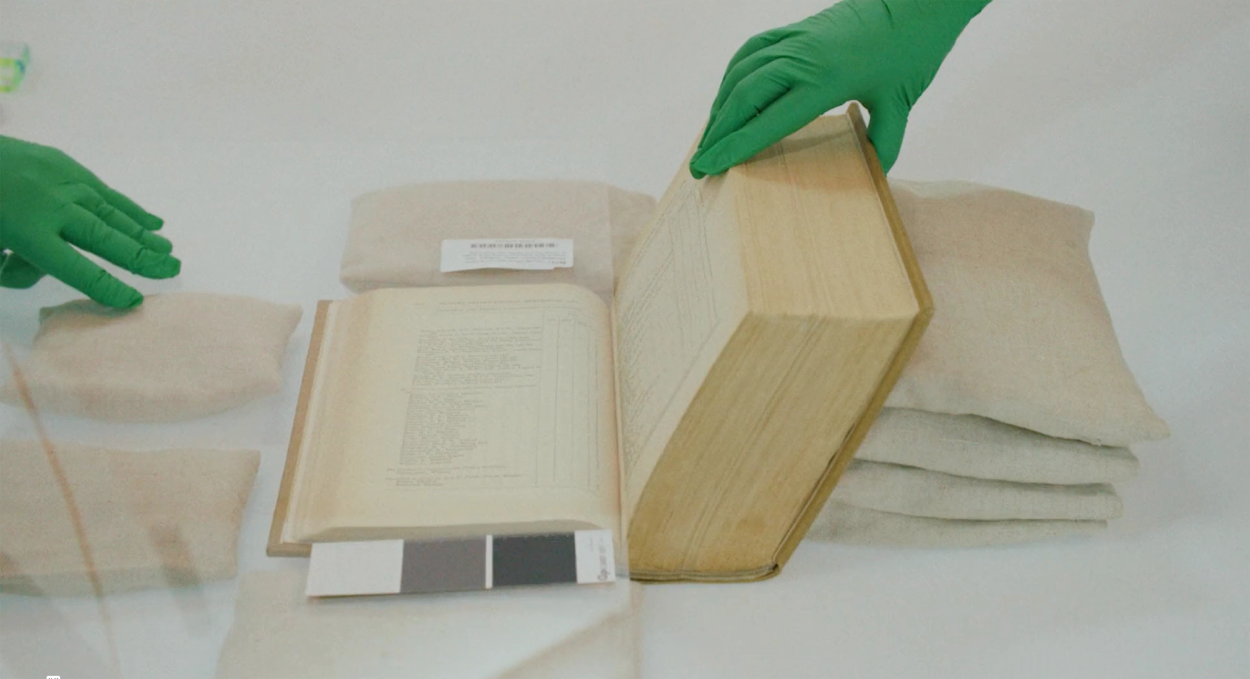
The first day brought lessons in paper conservation with Margaret Jurasek. Paper conservation?? What would a textile manager possibly learn from a Paper Conservator? I was impressed to learn the importance of simple sand bags when displaying books and picked up a variety of skills from making mylar mounts and folders to the ‘art’ of box making – not just any lidded box but the hinged, foam lined, cotton tape enclosing, photo labelled type! Necessary skills for a textile volunteer in a low budget regional museum.

Across the room, I met the talented Gosia Dudek who shared with us the magic of building displays using simple ‘pins’, silicon tube and fishing line! She gave me real skills for presenting professional displays securely. Whilst in the conservation lab, we also learnt to absolutely not rub any preparation into our leather and timber objects. This is a revelation for decades of well-meaning volunteers everywhere armed with Mr Sheen or linseed oil!

Range of tools required by Conservators to build displays. Photography by Marsha Rennie

Range of tools required by Conservators to build displays. Photography by Marsha Rennie

In the basement, I not only got to visually feast on the collection but observe real storage solutions for our Manning Valley Museum. This rack on castors would be the ideal answer to our dilemma of storing large garment boxes in our back workroom. It would allow extra storage whilst being able to easily access our permanent shelving too small for garments.

Photography by Marsha Rennie

Photography by Marsha Rennie

Even when not actively engaged in a ‘lesson’ – opportunities to professionally ‘develop’ abounded. Just wandering through the ‘transit’ area and examining the Powerhouse Museum curators wish list items gave me reason to reflect upon our own accessioning choices now and into the future.

Anni Turnbull the Social History Curator, was the fresh set of eyes I needed to immediately see the opportunity to breathe life into our SES exhibit- a corner of our museum that had seemed like just another collection of objects. It was suggested that we dig up old newspaper articles of rescues that had been carried out by the men who had used the equipment.

Photography by Marsha Rennie

Photography by Marsha Rennie

Both Anni and Diana Lorentz explored the undeveloped potential of our museum to represent the story of our buildings history and this was best demonstrated by exploring the Powerhouse’s “What’s in store?” exhibit. Diana and Malcolm McKernan also helped me develop a strategy to highlight significant objects amongst our ‘clutter’, improve our signage and explore the potential for storage to be developed on the exhibit floor itself.

The internship surpassed all expectations. It was a pleasure and an inspiration to meet so many passionate and generous professionals giving freely of their time and knowledge to enhance our humble regional museum.

Marsha Rennie
Manning Valley Historical Society Volunteer

The finer details of textiles storage

Textiles-storage-013-450x337.jpg

The first group of the week to take part in the object handling refresher. Photography by Melanie Pitkin.

This week staff from the Museum’s curatorial, registration and conservation departments took part in an object handling refresher focusing on the Museum’s vast textiles collection with Registrar, Sarah Pointon and Conservator, Suzanne Chee. For the past few months, Sarah and Suzanne have been doing an incredible job re-housing some of the Museum’s most beautiful textiles in the basement, not only improving their accessibility to staff, researchers and members of the public participating in basement tours, but also concentrating on the finer and often overlooked details of what it takes to achieve best level storage practices.

Textiles-storage-0021-450x337.jpg

Assistant Collections Manager, Einar Docker demonstrates the single sheet of acid free tissue used to protect textiles. Photography by Melanie Pitkin.

Sarah started the session by explaining the move to using one single sheet of acid free tissue paper to protect garments in storage trays as opposed to several sheets arranged together. When returning a tray into a drawer, the individual sheets of tissue (whose lightweight means they are very sensitive to movement) often bunch up or slide around and can be prone to catching on heavily embroidered or detailed garments. By using one single sheet, the sides can be gently tucked in to prevent movement and you can easily lift the sheet in one go (an especially practical capability for those curators among us who lead group basement tours and move about from one stored garment to the next!).

Textiles-storage-0051-450x337.jpg

Photography by Melanie Pitkin.

Textiles-storage-020-450x337.jpg

Sarah shows the little details to make object packing and storage easier. Photography by Melanie Pitkin.

To make sure we cut the single sheet of acid free tissue to the right size of the storage tray each time, Sarah and Suzanne attached a piece of fabric to the correct length of the tray to our packaging rack (as Sarah demonstrates above).

Textiles-storage-022-450x337.jpg

Every object is tagged and barcoded (see around the tops of the coat hangers). Photography by Melanie Pitkin.

The Museum also physically labels every object. In addition to a number written on a fabric strip, which is then sewn to a concealed part of the garment, an acid free paper tag describing the object, its location and barcode is placed with it (in the case of the vests, above, they hang around the neck of the coat hanger). To minimise object handling, all tags suspended from the coat hanger face in the same direction (to the left). But, of course, they only continue to hang in that direction if we all remember to return the label to its original position!

We were also reminded of the importance of working with and handling objects more generally, not just in terms of textiles, and I’ve decided to include them here:

1. Always wear gloves when handling objects both for the object’s protection, as well as your own
2. Lift objects – never drag, push or pull them. Lift objects by their most stable surface – never use handles or other projecting parts.
3. Don’t stack fragile objects such as ceramics and glass.
4. Pad objects with pillows and tissues to prevent rolling and vibration.
5. Some objects may need to be secured by ties and straps during transit. Always use a barrier between the tie and the object.
6. Ask for assistance with the move if you are not confident doing it yourself. Always ask for assistance when moving large or heavy objects and large paper objects.
7. Use as few moves as possible. Move the trolley/tray etc. to the object, not the other way around.
8. Always use special equipment such as tweezers for stamps, flat support boards for paper objects etc.
9. Cover objects when it is required to move them outdoors
10. Never rush as this is when accidents are most likely to happen

You can never be reminded of safe object handling practices too many times and the Museum organises such refresher sessions as these on a fairly regular basis to ensure consistency and best standard practice across all departments working with collections. As further upgrades to our storage takes place, we will also share these with you on our blog.

Design underground #2- telling stories about textiles

B7W0743-450x300.jpg

Photography by Sotha Bourn © Powerhouse Museum, all rights reserved

On Wednesday 4 August, Christina Sumner, Principal Curator Design & Society, led an enthusiastic group of twelve visitors on a design underground tour of the Museum’s textiles collection. Visitors were treated to an up close and personal encounter with eight key textiles spanning the 14th-20th centuries and various geographical regions, including: Australia, India, Bangladesh, Peru, Italy, Tahiti, West Africa and Turkmenistan.

One of the first textiles Christina showed the group was this Tahitian tiputa (poncho) made from bark cloth, c.1815 (above). The tiputa is special on several counts: certainly as it’s nearly 200 years old and a rare example of top quality tapa from Tahiti, and for the evidence of European influence in the leafprint pattern, but also for its association with Governor Lachlan Macquarie to whom the tiputa once belonged. It was good to give this an airing as 2010 is the bicentenary of Macquaries’s appointment in 1810 as governor to the colony of New South Wales.

B7W0722-450x300.jpg

Photography by Sotha Bourn © Powerhouse Museum, all rights reserved

Above is a tapestry-woven top, made from lama or vic?na wool in pre-Columbian South America between about 1400 and 1600. The group were in awe of its astounding condition and bright colours (remember, it is 500 years old!), the use of tapestry weave and the identification of the small repeating feather motif, which in one section, actually appears to have been carefully repaired at some time.

B7W0764-450x300.jpg

Photography by Sotha Bourn © Powerhouse Museum, all rights reserved

Both the pre-Columbian top and the West African Hausa man’s embroidered tunic (above) are made from narrow strips of handwoven cloth sewn together lengthways. However, while the top is tiny, the white cotton Hausa tunic – known locally as a babba riga – is huge by any standard. The narrow strips of cloth for these men’s tunics were woven by men and traditionally they also carried out the embroidery.

B7W0778-450x300.jpg

Photography by Sotha Bourn © Powerhouse Museum, all rights reserved

The group inspected the embroidery on the tunic closely, examining the couched pointed motifs known as ‘eight knives’ on the front pocket and over the shoulder, and the dense areas of eyelet embroidery known as ‘one thousand ant holes’. Today these tunics are still worn, but are almost all machine woven and decorated.

B7W0793-450x300.jpg

Photography by Sotha Bourn © Powerhouse Museum, all rights reserved

In addition to having a close look at traditional textiles from Tahiti, South America and West Africa (as well as India, Bangladesh, Turkmenistan and Australia) the group also saw a length of luxurious purple velvet from 16th century Europe. Velvet weavers, being keen to attract a good share of the market, developed a number of techniques in order to create a variety of attractive special effects. The technique used to weave this piece is called ‘pile on pile’, in which the pattern is created by cutting the velvet pile to two different lengths. This particular ‘pile on pile’ design was used by Venetian magistrates of the 16th century as a badge of office.

Christina Sumner and Melanie Pitkin

Editor’s note: Next week, some fellow curators will be leading a number of other design underground tours, including one on shoes, couture and lace! Check out the Sydney Design website for more information.

Design underground #1 – In the fashion vault

00z54263-450x300.jpg

Photography by Sotha Bourn © Powerhouse Museum, all rights reserved

Yesterday afternoon we kicked off the Design Underground tours as part of Sydney Design 2010 with an insightful, behind-the-scenes look at the expansive storage facilities of the Museum’s costume and accessories collection. Led by Suzanne Chee, the tour started with an overview of conservation work at the Museum and the breadth of the fashion collection. The first garment the group encountered was a crocheted dress designed by Romance Was Born and worn by Cate Blanchett at Federation Square, Melbourne in September 2009 (see image below). Dubbed by some as the ‘old-school granny rug’, the dress certainly turned a few heads among the group!

romancewasborn-450x600.jpg

Collection: Powerhouse Museum

But, in order for garments like this to be kept in good condition, you need to ensure the correct climatic and humiditiy conditions and appropriate storage measures. Compared with the display of objects in exhibitions where the temperature is maintained at around 20 – 22 degrees, the long term storage of textiles requires a slightly cooler and constant temperature of 18 degrees (with a 50% relative humidity). When the store was setup in the 1980s, it was modelled on the Costume Institute at the Metropolitan Museum of Art, New York and The Kyoto Costume Institute (which have lots of hanging space). But, overtime, the Museum has increasingly opted to lay garments flat as this reduces the pressure placed on the shoulders and the seams created by hanging. This is moreso the case for the ‘heavier’ garments of the 18th and 19th centuries.

00z54275-450x286.jpg

Photography by Sotha Bourn © Powerhouse Museum, all rights reserved

Textile lengths, rugs and yardage are stored on aluminiuim rolls protected and covered with acid free tissue paper which can be easily moved about for study and display. Accessories, such as shoes, bags and gloves, are displayed flat in trays and filled with padding to help retain the object’s form.

00z54273-450x300.jpg

Photography by Sotha Bourn © Powerhouse Museum, all rights reserved

In the above image Suzanne shows the group how hats are stored and cared for. This is a Rugby League cap dating to 1914. It is placed on a wooden hat stand with a padded support shaped exactly to the size of the cap (if it was going to be displayed, it would be on an acrylic stand instead as it is slightly more pleasing to the eye!). The hats, as with a large part of the dress collection, are stored in compactus units, as you can see below.

00z54277-450x300.jpg

Photography by Sotha Bourn © Powerhouse Museum, all rights reserved

Following the tour, Suzanne showed the group how to make their own padded coathangers (of Museum standard!) to display their own precious garments over light refreshments. Everyone was particularly impressed by Suzanne’s ‘textiles-inspired’ cupcakes which were devoured in no time!

00z54283-450x300.jpg

Photography by Sotha Bourn © Powerhouse Museum, all rights reserved

If you’d like to take part in any other upcoming Design Underground tours, please click here or download the Sydney Design iPhone app here. The next tour we’ll be blogging about is ‘Telling Stories About Textiles’ with Principal Curator, Design and Society, Christina Sumner.

Suzanne Chee, Conservator and Melanie Pitkin, Curator