Author Archive for Geoff Barker

Discovery of 400 World War One Photographic Portraits

studio portrait of four WW1 soldiers

85/1286-1005 Photographic negative, studio portrait of four soldiers, A Wedmore [Driver], G W Ralston, W C Potts, World War One Gunners, 21 Howitzer Brigade, and one unidentified man, glass / silver / gelatin, owned by Tyrrell’s bookstore, Sydney, 1916-1918

Sometimes museum work can take a long time to bear fruit and this collection of World War One portraits is a case-in-point. For most of the twentieth century they were buried within the huge collection acquired by James Tyrrell, the Sydney bookstore owner. Presumably he had acquired them in the 1920s and 1930s, either as part of one of the commercial studio collection’s built up by Charles Kerry and Henry King, or separately at one of the many auction’s he must have attended.
Continue reading ‘Discovery of 400 World War One Photographic Portraits’

Portable Writing Desk of David Lennox – Colonial Bridge Builder

Portable writing desk, owned by David Lennox, used in New South Wales, Austtralia, Powerhouse Museum Collection

Portable writing desk, thought to have been owned by David Lennox, donated by the Royal Australian Historical Society, Powerhouse Museum

This writing desk is linked to an important figure in Australia’s early colonial history. It is thought to have been owned by David Lennox who arrived in Australia, in 1832, seeking his fortune. An artisan by trade Lennox’s road to success was initially linked to  Major Thomas Mitchell.

In 1828 Mitchell had been appointed Surveyor-general of New South Wales and he set about improving internal communications along roads to the west and south from Sydney. Mitchell was faced with a lack of capable artisans and in particular he needed someone with knowledge and experience of design and construction of bridges. This was because the wooden bridges were often badly made and subject to destruction by fire and flood.

Continue reading ‘Portable Writing Desk of David Lennox – Colonial Bridge Builder’

Edward Hanlan – world champion rower

Commemorative mug, presented to Edward Hanlan world champion sculler, 1880-1888, Powerhouse Museum, A7779

Commemorative mug, presented to Edward Hanlan world champion sculler, 1880-1888, Powerhouse Museum, A7779

This Commemorative mug celebrates the achievements of Edward Hanlan who first came into prominence as a sculler in 1880, when he defeated the Australian Edward Trickett for the world’s sculling championship. Trickett had earlier won the title in 1876 by defeating J. Sadler and had retained it on his return to Australia, beating both M. Rush and Laycock.

Continue reading ‘Edward Hanlan – world champion rower’

Instrument of Torture – the thumbscrew

Thumbscrew, torture device, date unknown, Powerhouse Museum

Thumbscrew, torture device, date unknown, Powerhouse Museum

The image above is of a thumbscrew which I came across here in the Museum’s collection while looking for something far more innocuous – a wooden mallet made from a girder of the old Sydney Stock Exchange.

Continue reading ‘Instrument of Torture – the thumbscrew’

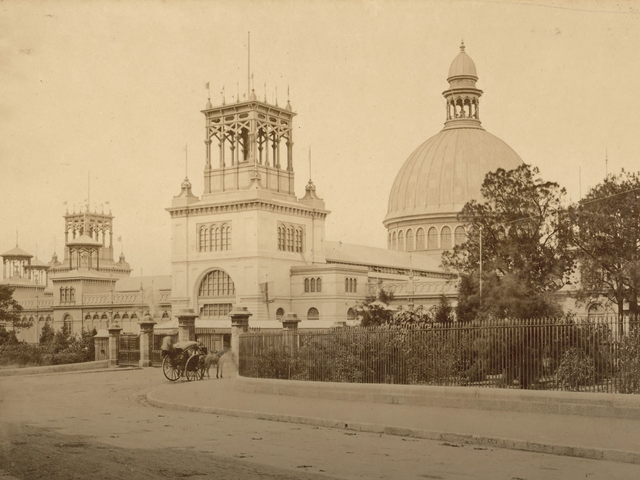
Trial by Fire – the formation of the Powerhouse Museum’s collections from the ashes of the Garden Palace

Garden Palace Fire 1882, lithograph from Illustrated Sydney News Supplement, Powerhouse Museum Collection, P2239

Garden Palace Fire 1882, lithograph from Illustrated Sydney News Supplement, Powerhouse Museum Collection, P2239

The story of the creation of the Powerhouse museum starts with the project to host an international exhibition in the grounds of the Sydney Domain in 1879. Based on similar displays in London and Paris it drew from around the world all manner of objects relating to the industrial and applied arts. Continue reading ‘Trial by Fire – the formation of the Powerhouse Museum’s collections from the ashes of the Garden Palace’

Aboriginal Breast Plates

Engraved breastplate, presented to aboriginal man “Harry Mulbah/Chief of Berrallawah”, brass, maker unknown, 1845-1850, Powerhouse Museum A7765

Engraved breastplate, presented to aboriginal man “Harry Mulbah/Chief of Berrallawah”, brass, maker unknown, 1845-1850, Powerhouse Museum A7765

Aboriginal breastplates, like this one, are rare reminders of the relationships that once existed between the Indigenous population of Australia and the European colonists. These breastplates were similar in design to the gorgets worn by Officers in British Regiments and were tailor-made for the recipient  As a result the inscriptions and motifs are significant records from the early colonial period right up to the 1930s when they appear to have stopped making breastplates.

Continue reading ‘Aboriginal Breast Plates’

Ben Hall, Australian Bushranger

Poster, Bushranger 'Reward Notice', 1000 pounds offered for each of the following, Ben Hall, John Gilbert, John O’Malley and John Vane, 1863, Power...

Poster, Bushranger ‘Reward Notice’, 1000 pounds offered for each of the following, Ben Hall, John Gilbert, John O’Malley and John Vane, 1863, Powerhouse Museum P.237/30

 In the years following the 1850s gold rush a new breed of entrepreneur, the Australian bush ranger, took center stage. And even though they held up gold and mail coaches, killed travellers, and in some instances took entire town’s hostage many have been described favourably by historians. Why?
Continue reading ‘Ben Hall, Australian Bushranger’

Expedition to establish first Meteorological Observatory Kosciuszko, 1897

Expedition to establish first Observatory (detail), by Charles Kerry, Kosciuzko, New South Wales, Australia, 1897, Powerhouse Museum, 85/1284-1337

Expedition to establish first Observatory (detail), by Charles Kerry, Kosciuszko  New South Wales, Australia, 1897, Powerhouse Museum, 85/1284-1337

There are numerous ways in which information is added to our collection. One of the most obvious is a result of the work done by staff to update our records but another important source of information comes as a result of the continual enquiries and suggestions from the general public.

A really good example of this occurred a few months back when I received an email from Adrian Ingleby enquiring about some photographs the Powerhouse Museum held relating to the ascent of Mount Kosciuszko to establish the first observatory there. Adrian’s interest was in a relative of his Bernard Ingleby (you can see him above, he’s the young guy on the right wearing the beanie) who accompanied Clement Wragge on this expedition. After a few discussions and an exchange of emails Adrian put me on to a wealth of amazing information about two of the photographs which were in the collection, and this post is a result of that exchange.

Continue reading ‘Expedition to establish first Meteorological Observatory Kosciuszko, 1897′

Henry Parkes, Father of Australian Federation

Portrait of Sir Henry Parkes, Sydney, Australia, 1880-1896, Powerhouse Museum, 85/1286-481

Portrait of Sir Henry Parkes, Sydney, Australia, 1880-1896, Powerhouse Museum, 85/1286-481

Sir Henry Parkes was one of Australia’s more significant politicians and journalists and the Museum’s collection of objects relating to him is a varied one. It includes objects representative of his years as a manufacturer of domesticware, toys and turned wood and ivory articles. Two of ivory handles included in this group were turned by Parkes in his shop at No. 9 Hunter street which he occupied from 1847 till 1852. Other objects, which also bear the mark ‘Henry Parkes and Co.’, were imported from overseas and retailed from the shops he ran throughout most of his career.

Continue reading ‘Henry Parkes, Father of Australian Federation’

The Water Pipeline to the Broken Hill Mines

Water pipeline from the line from Umberumberka to Broken Hill,, Powerhouse Museum, NN10266

Water pipeline from the line from Umberumberka to Broken Hill,, Powerhouse Museum, NN10266

These sections of pipe originally connected the outback mining town of Broken Hill with its the water supply at Unberumberka Creek. They remain significant reminders of just how difficult it has been for the town to find water for both its townsfolk and the silver, lead and zinc mining for which it is famous. In 1883 the Broken Hill Proprietary Company (BHP) founded the town and initially the water came from small dams and wells. The scale of the mineral deposits however in this semi-desert region of Australia meant the town and the mines were soon out of water.

In 1892 a private water company, the Broken Hill Water Supply Company Limited was formed to build a new water supply from the Stephens Creek Reservoir but by 1901 even this was running out of water. To solve this problem a new dam was built at Umberumberka Creek and construction began in June 1903; unfortunately and somewhat suprisingly a flood in 1903 swept away the partially complted dam and works were stopped. In 1907 the project was resurescted and by 1914 the dam and 19 miles of pipeline, of which these appear to be parts, had been completed.

Water pipeline, parts from the line from Umberumberka to Broken Hill,, Powerhouse Museum, NN10266

Water pipeline, parts from the line from Umberumberka to Broken Hill,, Powerhouse Museum, NN10266

The water was initially pumped from the damn to a balance tank at Blue Anchor Hill and from there gravitation allowed the water to make its way to Broken Hill. This pipeline was primarily of a wooden stave construction eighteen inches in diameter but in some places where the pressure was high a steel pipe was used. The smaples here would have been bound in steel wire and coated with pitch and although servicable they were prone to leaking and required a high level of matainence.

This object is part of the Royal Australian Historical Society (RAHS) collection which was donated to the Powerhouse Museum in 1981. The Society was formed in 1901 and is the oldest historical society in Australia.

Geoff Barker, Curatorial, 2012

References
Broken Hill Water Supply Umberumberka Waterworks Submission To Engineering Heritage Australia For An Historical Engineering Marker http://www.engineersaustralia.org.au/sites/default/files/Umberumberka_Nomination.pdf