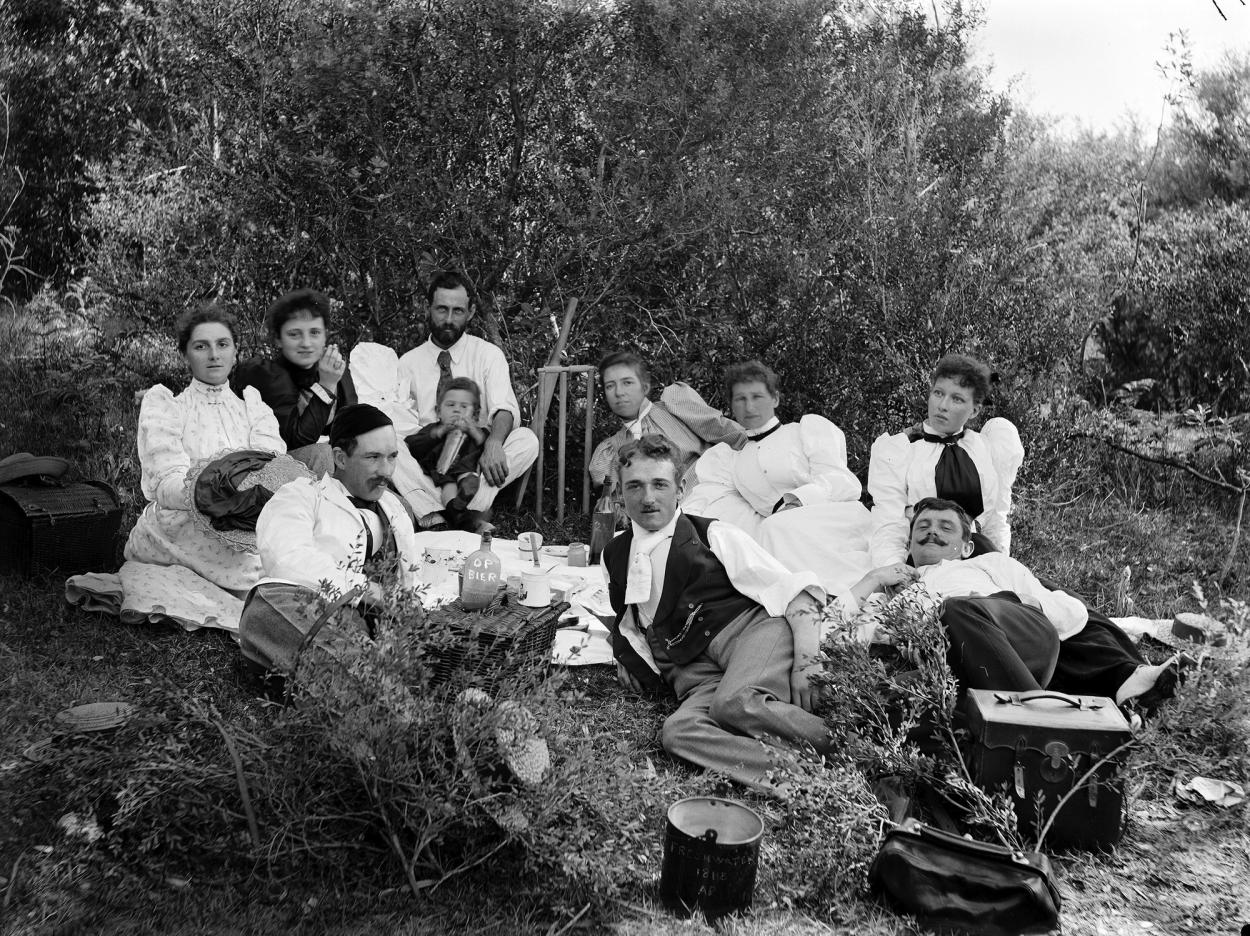
Expedition to establish first Observatory (detail), by Charles Kerry, Kosciuszko New South Wales, Australia, 1897, Powerhouse Museum, 85/1284-1337
There are numerous ways in which information is added to our collection. One of the most obvious is a result of the work done by staff to update our records but another important source of information comes as a result of the continual enquiries and suggestions from the general public.
A really good example of this occurred a few months back when I received an email from Adrian Ingleby enquiring about some photographs the Powerhouse Museum held relating to the ascent of Mount Kosciuszko to establish the first observatory there. Adrian’s interest was in a relative of his Bernard Ingleby (you can see him above, he’s the young guy on the right wearing the beanie) who accompanied Clement Wragge on this expedition. After a few discussions and an exchange of emails Adrian put me on to a wealth of amazing information about two of the photographs which were in the collection, and this post is a result of that exchange.
Wragge’s expedition set out, just four months after Charles Kerry had completed the first winter ascent of the mountain, but Wragge’s summer ascent was to establish an observatory from which to measure weather. This was the brainchild of Clement Lindley Wragge, an Englishman, who had been appointed Queensland Government Meteorologist in 1887. Wragge certainly appears to have had a passion for the establishment of weather stations. Not only did he set up dozens in Queensland he was also responsible for helping establish stations in Fiji, Norfolk Island and New Guinea.
Wragge’s interest in Kosciuszko was because the summit could provide readings of the upper atmosphere from the highest point which could then be compared with sea level station on the coast at Merimbula. The idea was supported by the Royal Society the Royal Meteorological Society as well as attendees at the 1896 International Meteorological Conference in Paris.

Expedition to establish first Observatory on Kosciuszko New South Wales 1897 (detail), by Charles Kerry, Powerhouse Museum, 85/1284-1337
When the expedition set out from Jindabyne 2 December 1897 they were assisted by the Sydney photographer Charles Kerry, who himself had completed the first winter ascent only months before. The make up of the party was as follows: Clement Lindley Wragge, Charles Kerry, Clement Egerton Wragge (Wragge’s son), Lieutenant Pocock of the Queensland Defence Force, Mr Fowles (of the Brisbane bureau), Captain Charles Iliff (a Cape Moreton mariner who would oversee the weather station), South Australian Bernard Ingleby, who would act as first observer, journalist Mr Wilkinson of the Daily Telegraph, James Spencer a guide (I’m pretty sure he’s the dude on the left with the bushy beard) and Murray Napthali who was in charge of the dray which was to bring the bulk of the instruments and supplies. Second observer was to be Basil de Burgh Newth, who would join the expedition at Kosciusko. Two days later they were setting up their tents on the summit; the unfortunate Mr Napthali had to struggle with the dray for several more days before all the supplies finally made it to the top.

The first Meteorological Observatory on Kosciuszko by Charles Kerry, 1897, Powerhouse Museum, 85/1284-2848
This is the second photograph of interest. In it we can see the final encampment at the summit after the instruments had all be set up the 10 December. Even though it was summertime in Australia the conditions were still pretty adverse; you can see the fierce winds billowing out the kitchen tent on the right tent, and at night the temperatures dropped below freezing. No wonder they can all be seen wearing coats and hats.

The first Meteorological Observatory on Kosciuszko (detail), by Charles Kerry, 1897, Powerhouse Museum, 85/1284-2848
This detail from the image above gives you a clearer view of the meteorological instruments, they are from left: “trig disc’; the rain gauge (this is the post you can see in the foreground) ; and the barometer gauge hidden in the cairn of rocks next to the Arctic tent.

The first Meteorological Observatory on Kosciuszko (detail), by Charles Kerry, 1897, Powerhouse Museum, 85/1284-2848
In this second detail we can see the thermometer screen, and provisions tent. The person on the far right is Bernard Ingleby, first observer and if we look closely at the foot of the man next to him it seems a dog may have accompanied Basil Newth on his ascent.
Wragge left the observatory on the 11 December and it was left to Iliff, Ingleby and Newth, to stay and make the observations. However two months into their observations, and 115 years ago to this day, a terrific storm assailed the observatory. This blew the thermometer screen down and tore at the tent with such force the young men were forced to make their way back to Jindabyne. In early 1898 a more permanent hut was erected and the group which wintered on the summit included: Ingleby, Newth, and a young Danish scientist H. I. Jensen.
The station was eventually closed in 1902 due to funding issues in the wake of Federation, and a lack of support from other meteorologists across the states.
Geoff Barker, Curatorial, TAM Project, 2013
References
Wragge’s summit station, The Mount Kosciuszko weather observatory, 1897-1902, Matthew Higgins, Canberra & District Historical Society Inc., New Series No. 20 September 1987
A Winter on Mt Kosciusko, H I Jensen, The Lone Hand, The Australian Monthly, June, 1909
Kosciuszko Expedition, The Daily Telegraph, December 15, 1897
A Chat with Captain Iliff, The Brisbane Courier, May 1898