
Powerhouse Museum Collection Search 2.53
Category history:
   
Absolutely Mardi Gras
In the twilight of the first Saturday in March, gay men, lesbians and transgenders from across the city and across the globe assemble in Sydney. Organisations, groups and individuals come together on floats, in marching groups or as whimsical costumed entries. As the night progresses, the parade snakes its way between the crowds lining Oxford Street creating a colourful and joyous blend of music, movement and community pride.

The sense of fun and freedom brought by the night pervades the parade and its spectators. For one evening, the boundaries between revellers and onlookers, between queer and straight, are dismantled. In one sense, the community that celebrates Mardi Gras is Sydney itself.

Images of Mardi Gras parade through our memories. Who can forget the giant Imelda chasing her shoes down Oxford Street, the head of Reverend Fred Nile on a platter surrounded by the Sisters of Perpetual Indulgence, the advent of the all-girl and all-boy dancing troupes? Growing in size and diversity, the Sydney Gay & Lesbian Mardi Gras has transformed from march to spectacle; it has become a major cultural force. This month-long celebration is now the world's largest gay and lesbian arts festival. As a gay pride march, it is unique. Whereas other cities around the world hold marches during the daylight hours, in Sydney there is Mardi Gras - a night-time carnival, a wild celebration where serious issues are dealt with humorously.

The Mardi Gras festival is also one of Australia's most significant economic and tourist events, attracting thousands of people from interstate and overseas to Sydney and generating tens of millions of dollars. As attendance at the Sleaze Ball and Mardi Gras parties reach the 20 000 mark, and those for the parade zoom over 650 000, the question of these events mainstreaming also hangs from many lips. When ABC television first screened the parade in 1995, 40 per cent of the possible viewing audience tuned in. These national telecasts and the Absolutely Mardi Gras exhibition at Sydney's Powerhouse Museum indicate a climate of acceptance so different to Mardi Gras' radical beginnings.

What was punishable and reviled 20 years ago has now become acceptable and even fashionable! Why? How did Mardi Gras evolve? Well, in the beginning there was Stonewall.

Early on 28 June 1969, New York City police officers launched a 'routine' raid on the Stonewall Inn, a Greenwich Village gay bar. The police had little reason to expect trouble, since homosexuals rarely resisted them for fear of drawing further attention to themselves. But that night they began to protest loudly in the street, chanting GAY POWER! Several nights of confrontation sparked meetings and rallies and gave birth to a multitude of gay liberation groups. Stonewall came to be seen as the genesis of the modern gay rights movement with mythic significance.

The Sydney Gay & Lesbian Mardi Gras (SGLMG) had a no less tumultuous birth. The 1960s and 70s was a time of radical change in Australia: the war in Vietnam and the moratorium marches, Aboriginal civil rights, women's rights and the political upheavals of the Whitlam era meant that society's attitudes towards oppressed and alienated groups were not what they were. For the gay and lesbian community, it was a decade of activism that was to culminate in the first Mardi Gras.

In March 1978, two Sydney gay activists received letters from the 'Gay Freedom Day Committee for Cultural Affairs' in San Francisco signed by Paula and Bud, a lesbian and a gay man ('Paula Bud' is not, as some thought, a full name). Was there any interest in celebrating an international day of gay solidarity to mark the tenth anniversary of Stonewall? The Sydney activists wrote to some 20 groups asking if they wished to take part. Out of this, the Gay Solidarity Group (GSG) was formed to organise a program of events and encourage interest in gay political activism. A street parade, complete with music, costumes and dancing, was one of the ideas put forward.

There are several interpretations as to why this form of activity was chosen. One of the organisers of the first parade later recalled that the GSG 'wanted a way to involve people in the streets that wasn't as confronting as a Saturday morning march where people's faces appeared on television. Something that would be a celebration of gay and lesbian freedom, a real celebration'. Already some marches in the United States had a more festive atmosphere. Other people believed that the idea of masking one's identity in fancy dress was a good means of disguise (see Chapter 2). And there are those who saw it as a considered move to encourage political activism from a previously reluctant group.

'There was tension between the bar scene-the gays and lesbians who went to bars-and the gay and lesbian political activists who were radicals. The Mardi Gras parade at night was a bridge, quite consciously, towards the scene.' Craig Johnston.

Whatever the reason, the celebrations were held on Saturday 24 June 1978. The first event, a morning march from Sydney Town Hall, was followed by a public meeting at Paddington Town Hall. Both events were well attended and when the evening parade and festival (as it was billed) began at 10.30 pm, between one and two thousand people took part.

The crowd chanted OUT OF THE BARS AND INTO THE STREETS! as it
progressed down the 'gay-mile', the stretch of Oxford Street between Taylor Square and Whitlam Square where some of Sydney's gay night-spots were then located. However, it was at 11 pm, when the parade reached the entrance to Hyde Park that trouble began. The police wanted the crowd to disperse but confiscated the lead truck and its public address system before an announcement to do so could be made. Chants of STOP POLICE ATTACKS/ON GAYS, WOMEN AND BLACKS! went up opposite police headquarters. Blocked from entering the park and still in a jubilant if somewhat confused mood the crowd decided to continue 'and the only way was up' - to Kings Cross, an alternative centre of gay life in Sydney. The atmosphere became more like a 1970s protest march. When the police wagons moved in and officers removed their identification badges the crowd knew the confrontation was about to escalate. Fifty-three arrests were made.

'It was dykes who were at the forefront of the riot. They came from a strong tradition of feminism and street politics and street confrontations with cops, so they were the ones who took the risks initially. The queens in the initial riot were hiding under cars... throwing their hands up in the air, going "This is a nightmare"... The women had the strength.' David McDiarmid.

'I'd gone along expecting a mardi gras and finished up in a humdinger of a riot in Kings Cross. Because of the police, it's grown to what it is today. Perhaps without that riot, we wouldn't have had Mardi Gras...lt was terrifying. It was very violent.' Peter Tully.

Reaction to this police action was both swift and long-lasting. Rallies, pickets and demonstrations took place all through that year and into the next, and over 100 other people were arrested. Eventually nearly all these charges were dismissed or dropped but not before a major Sydney newspaper had twice 'outed' those arrested, publishing their names, addresses and occupations.

'Sydney had its Stonewall moment, the necessary transforming moment, which galvanises and energises a people and a culture, and which makes great things possible.' Leigh Raymond

The legacy of that night was a bond between the gay and lesbian
subculture and the political activists. Mardi Gras had become not only a
political rally, it was equally suffused with the idea of 'community'.

The second parade would be a different affair with an even greater variety of events in the preceding week, including a film festival and a gay alternative fair in Hyde Park. The first 'dance party' was held as a fundraiser at the beginning of the week in Balmain Town Hall. Its style, with live music and a mobile disco, was that of the political left - more like a rather stagnant 21st birthday party than the hyper-staged ecstatic dance parties of the 1990s. Despite chilly relations with the authorities, people joined in and the atmosphere at the parade was peaceful and fun. Some of the impact was lost, however, because of the lack of any organised activity at the end.

This would be remedied in 1980. The Gay Solidarity Group set up a separate task force with the purpose of organising events for Gay Solidarity Week, including the first post-parade party which was held at the Paddington Town Hall for 700 revellers. The idea of a post-parade party was also a merging of the two strands of community life that met in the parades. It was common in the gay 'movement' to hold some kind of dance or social function as part of a political event. In fact, gay and lesbian life in Sydney had a strong history of dances and balls such as the Drag and Drain parties of the thirties and forties and the Artists and Models Balls of the fifties and sixties. The seventies and eighties saw the Knights of the Chameleons and Family Balls while social groups such as the Boomerangs and the Pollys ran dances. It was not surprising that the idea of a Mardi Gras dance surfaced.

Despite the uneventful 1979 parade, the Task Group were still concerned that problems might arise and in 1980 they organised parade marshals and a bail fund in case of arrests. However, the only hint of violence occurred when a group of lesbian activists took exception to a perceived racist display on 'The Barrel Inn' float, surrounded it and attempted to board.

Although that year's Mardi Gras may have given the appearance of being fun -about one-quarter of the participants were in costume - there was friction. Some political activists saw the parade as purely a commemoration of Stonewall. Others, including those with commercial interests, saw it as a mass celebration of gay lifestyles. The former, marching in ordinary street clothes emblazoned with badges, dismissed costume and dressing up as a frivolous display which threatened to undermine and trivialise the message of gay solidarity.

These sentiments were in keeping with general attitudes towards fashion at the time. However, more recent interest in popular culture studies has seen the role of fashion re-evaluated. It is now recognised that the wearing of costume in Mardi Gras does not negate the political message of the event.

Of course, there have always been those who believed the parade could combine both fun and protest. In 1980, however, the differences in attitude found a specific focus. There was the suggestion that the parade be moved from winter to summer - an idea given impetus by the parade taking place on one of the coldest June nights on record. As Leigh Raymond quips, it had been 'decided perversely to hold a Mardi Gras, a parade held elsewhere to mark the end of summer, in the middle of winter'.

The Gay Mardi Gras Task Group began formal public debate on the issue.

'Those objecting mainly came from the political left, especially radical feminist lesbians whose argument centred on the fact that a winter parade would lend itself to a political gay rights demonstration which would not be diffused by popular or commercial interests. The strongest supporters for the change came from those who had been more involved in the camp subculture.' Craig Johnston

In the end, the summer option was accepted and with it the whole atmosphere of the event was transformed. The goals changed from 'overturning the patriarchal system' to law reform. As a result, lesbians, who were the core of the political movement, became far less involved and were marginalised within Mardi Gras. Many returned to the women's movement. It was a situation that was to last until 1988, one that impacted on the look of Mardi Gras by giving full reign to the male performance tradition of drag within the parade.

The Mardi Gras Task Group was reformed in 1980 as an elected and independent body. It had scant time to organise the next parade which was set for 21 February 1981. Then the party venue was mysteriously gutted by fire and it was only days before the parade that Hyde Park South, an outdoor venue, was locked in. When the appointed day arrived, the weather turned and the first washout occurred. The parade did take place one month later but the outdoor concert was not a success and re-inforced the need to secure an indoor dance venue. However, the increase in parade participants from under 2000 to 5000 provided tangible support for those who were trying to create an event with broader appeal. In the following year its scale grew further as organisers actively encouraged gay-owned businesses to become involved.

Ironically, politics emerged from the shadows for the 1982 parade. Mardi Gras was given a theme for the first time and the one selected for that year was 'On our way to freedom', a reference to the struggle for homosexual law reform. It was a struggle bolstered by the growing attendances at the parade - over 10000 lined the route - making it obvious that gay rights were not necessarily a fringe concern.

There were further innovations in 1983. A festival was re-established under the banner of 'Our lives/Our selves, a festival for lesbians and gay men'. And more significantly, the workshop was set up under the direction of Peter Tully . Tully was one of the few to have dressed for the first parade in 1978 - he wore an American Indian outfit - and he was to have a major impact on the entire look and feel of future Mardi Gras.

'There is nothing else like it. There are other parades and things but they're a bit commercial, a bit safer, a bit more compromised, and a bit cliched.' Peter Tully

'Although I agreed with the issues, I didn't think it would last very long. Visually it had to be much more exciting and much more attractive for people to take to it in a big way. So we started working on the visual side of it to make it more exciting, a bit more interesting, dynamic.' Peter Tully

Realising that they needed funds, the committee staged the first Sleaze Ball at Paddington Town Hall in September 1982 to raise money for the following year's Mardi Gras. The party theme, perhaps inspired by New York and Berlin parties of the 1970s and by a growing sense of sexual awareness, was a great success. However, it was clear that in future years a larger venue would be needed.

The Showgrounds had been booked for the party on Mardi Gras night in 1983; 6000 packed the AMP Pavilion. The gay press described the parade as an outstanding success but reported that the party (which was becoming as important to Mardi Gras as the parade itself) left much to be desired. To try to improve the situation, a more formal structure was adopted and the Sydney Gay Mardi Gras Association was formed.

The 1984 Sydney Gay Mardi Gras theme, 'We'll dance if we want to!', was chosen in response to police harassment of gay venues and their challenge to the 1983 Sleaze Ball's liquor licence application. In fact, applications for liquor licences were to cost considerable time, effort and money in the years up to 1994. This was a threat to the very existence of Mardi Gras which relied almost exclusively on the dance parties for funding.

The 1984 Mardi Gras party went onto be regarded by many as a watershed.

'It evokes the contemporary dance party formula - huge dance floor, music chosen for dance connoisseurs, drugs, sex and costume. It also suggests the male origins of Sleaze, and the meeting of… 'clones'…and the 'style queens', who introduced to Mardi Gras the elements of dressing up.' Oxford Weekender, 16 September 1982

Mardi Gras also relied on the new anti-discrimination amendments to get police and council cooperation for the parade. Crowd control was achieved by the use of marshals and, in later years, barricades. Considering the size of the crowd at 40000, these measures were none too soon coming! They also had an impact on costumes, lifting previous restrictions on size and extravagance. The growing spectator numbers had made it hard for some of the participants to move up the street in large and lavish creations. They would arrive at the other end exhausted with their costumes in tatters. So, while the look of the parade benefited from these measures, the closeness and intimacy that hallmarked earlier parades suffered.

Although the parade audience had grown over the years to tens of thousands, the mainstream media still largely ignored the festival until 1984 when SBS television commissioned a half-hour documentary. Meanwhile, the Mardi Gras elections of that year returned no women to the board, reflecting an increasing gay male separatism in the growing crisis over HIV/AIDS.

As the community celebrated achieving homosexual law reform in NSW in 1984, the mainstream media began to cover the issue of HIV/AIDS in a sensational manner. When Professor David Pennington, head of the AlDS Task Force, linked the post-parade party to 'a Bacchanalian orgy', the Reverend Fred Nile of the Festival of Light (a fundamentalist Christian political group) took it as a call for the cancellation of Mardi Gras. There had even been discussion among the gay community as to the appropriateness of staging Mardi Gras itself, but these views were countered by parade coordinator Brian Hobday who described it as 'a much needed show of strength'. The 1984 parade went ahead without problems, with an estimated 30 000 spectators and 8000 at the party.

This success along with the newly revived and expanded cultural festival made the 1985 Mardi Gras a ground-breaker. In the face of fierce opposition, it set the tone for years to come in terms of community cohesion and strength. A burst of activity became concentrated on Mardi Gras after the fight for law reform was won and this was reflected in the diversity of festival events including film, theatre, exhibitions, workshops and sport. The parade itself benefited as participants could feel liberated from the stigma of illegality while a new route made for a non - confrontational environment by avoiding the George Street cinemas, a likely Saturday night hangout for young homophobic men. In many ways, 1985 can be seen as the first of the contemporary-style Mardi Gras.

With a new management plan to improve efficiency, tighten financial control and reduce costs, the year would he labelled as the beginning of the 'professionalisation' of Mardi Gras. In subsequent years, the administrative reach of the organisation grew even greater, drawing criticism from those who saw the Mardi Gras moving away from its roots as a political event driven by volunteers and activists.

It was also the year of the first Showground 'concept party' for Sleaze - projects that would see the dance halls transformed into Mayan temples or littered junkyard landscapes. Dance attendees would dress to reflect the sleazy, sexually explicit nature of the ball. As a result, the Sleaze Balls became giant extravaganzas, taking on an importance of their own.

The parade was also changing - the first Dykes on Bikes and Koori entrants participated in 1988 in front of 120 000 people. Lesbian involvement, although increasing, was still not as strong as it could be. With major gay groups 'going coalitionist', members of the Sydney Gay Mardi Gras Association voted to include the word 'lesbian' in the organisation's name. The change was too late to appear on the 1989 posters but the intention signified a wider degree of community involvement.

In the years since, the Sydney Gay & Lesbian Mardi Gras has had an extraordinary impact on the straight community as well. There has been a gradual (and sometimes grudging) acceptance of gay and lesbian lifestyles as valid parts of the city's cultural diversity. Gay men and lesbians, who for so many years were a subculture on the fringes of the mainstream, are now often trendsetters for the rest of a youth-orientated society. As the differences between gay and straight in body image, dress, music, dance and other aspects of street and contemporary culture begin to blur, the issue of who you have sex with recedes in importance.

Gay men and lesbians have recognised the political and economic power in acting as a community, and have galvanised over the issue of HIV/AIDS. This has attracted an extra level of support from government, the police and the media throughout the year.

On another level, because it operates as a carnival or, as Umberto Eco writes, 'authorised transgression', Mardi Gras can only occur at a specific time and place. For one night, the queer community can suspend the control of the dominant culture, resulting in the dramatic expression of queer culture on the streets.

During the Mardi Gras festival, this is especially evident in the way Oxford Street is transformed from an urban thoroughfare to a processional way. Since 1990, flagpoles fly the Mardi Gras banners along the length of the route, while businesses decorate their windows and awnings with gay and lesbian imagery, utilising the rainbow colours of the gay and lesbian flag or creating variations of the Mardi Gras poster and theme for that year. In the week prior to the parade as the countdown begins, the excitement and energy along Oxford Street increases to a fevered pitch - ready for the explosion of sound, light colour, glitz and glam that is Mardi Gras night.

The festival stakes its claims even further into spaces that were
out of bounds in earlier times: Sydney Opera House, the Sydney Town
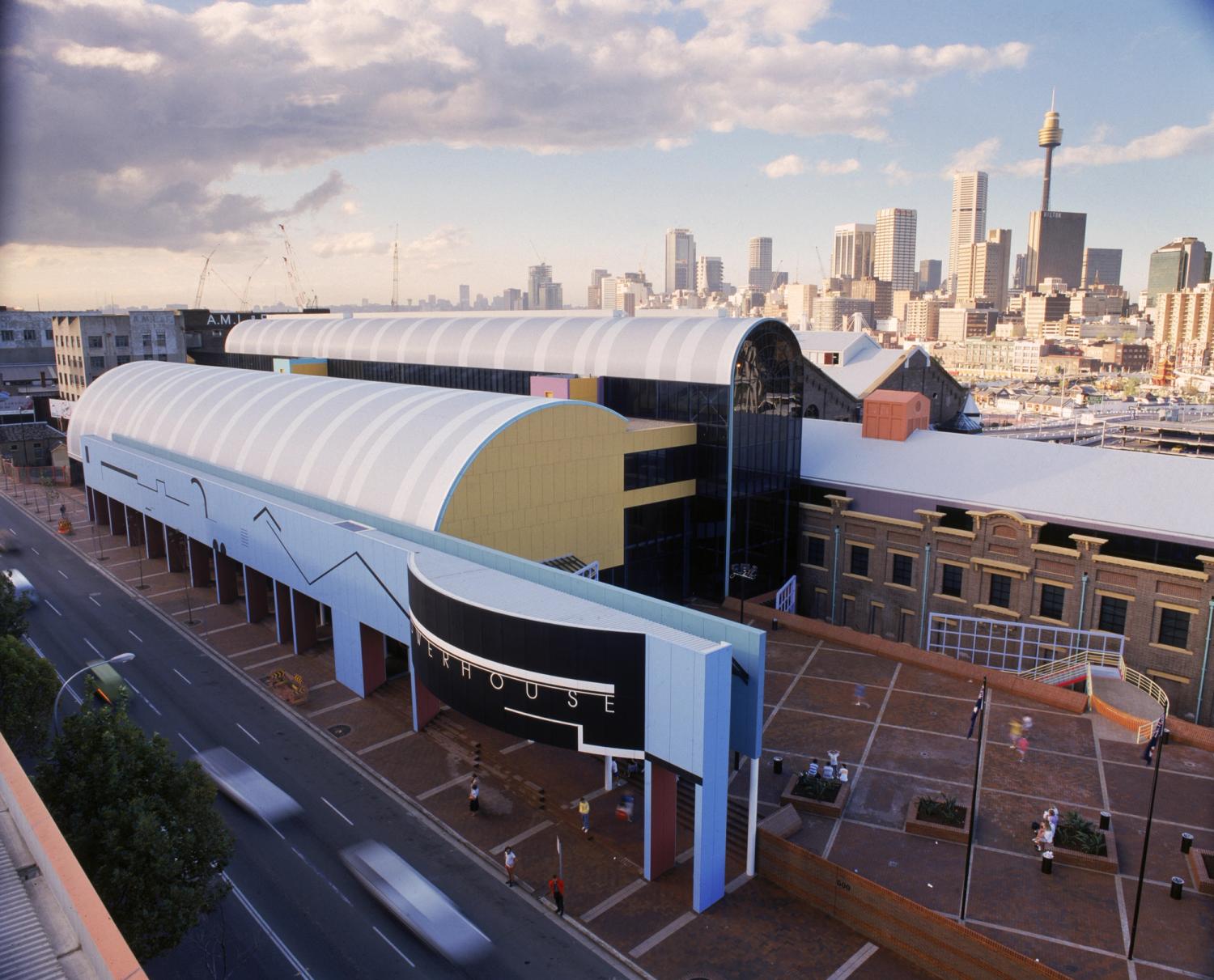
Hall, the State Theatre, the Powerhouse Museum.

In doing this, Mardi Gras projects a minority image onto the mainstream by saying 'we have a right to be here'. Its very existence is a political statement of tolerance and acceptance, and it has played a major role in the definition of a gay and lesbian 'space' in Sydney by creating a territorial and symbolic centre for the community in the inner-city. In a way, it allows gay men and lesbians in Sydney to be visible throughout the year, rather than for just a period in March.

However, this acceptance of Mardi Gras has not been without its problems. With the increasing number of heterosexuals attending the parties, there was concern that the celebrations would be transformed into another avenue for popular - and thus straight, dominant - culture. In 1996 SGLMG members voted overwhelmingly to ask prospective new and renewing members to state their category of sexual preference. Applicants indicating that they are gay, lesbian, homosexual and transgender are admitted as a 'matter of right' while those in other categories must go before a membership committee.

The SGLMG has also developed its support role for gay and lesbian cultural expression. The re-invention is particularly evident in the posters for the parades. In the first three years, these were produced in the style of political handbills by collectives associated with the Tin Sheds at the University of Sydney. Early imagery of the 'coming out' butterfly dominated in the years of Stonewall commemoration. However, with the change to late summer, the posters evolved into more relaxed expressions of hedonistic enjoyment. Those of the early eighties flaunt and celebrate the parade, the party and sexuality while those in the later part of the decade reflect a movement towards inclusion and coalition. In the nineties, the posters and imagery have a more sophisticated, commercial graphic style, mirroring the change in production from a competition to a commission for gay and lesbian designers.

The board of the SGLMG now encourages the commercial potential of the event. Poster imagery has been adapted for the marketing of T-shirts, CDs, and coffee mugs, and the logo, title and the poster design are copyrighted by the organisation. SGLMG is now not only a political force but a corporate one too. Its operations include office and workshop space and a permanent, professional staff of more than 12. Statements of gay and lesbian identity writ large on the streets of Sydney do not come cheap and require planning, coordination and fiscal responsibility.

The Mardi Gras has fostered a competitive spirit of design and production and a display of creative endeavour that - although some may say tacky - is uniquely Sydney. These creations strut, whirl and line the streets of Sydney's gay space from Darlinghurst to Newtown and say with tongue firmly in cheek. 'We are what we are!' They have emerged from the Mardi Gras workshop and the spare rooms and garages of gay men and lesbians all over Sydney. There is also a Hall of Fame for significant contributions to Mardi Gras and an awards system which encompasses costume, floats, marching groups, walking groups and store-front and business decorations, and which also apply to other festival events.

Mardi Gras is many things to many people - parade, political statement, carnival, fiesta, a way to come out. For some gay men and lesbians, it's the equivalent of Christmas - a time for the community to come together and share. Whatever it is, it continually recreates itself, snubbing those who would wish to define its limits.

'I think of Mardi Gras as a month of celebration. We show our stuff to the world, gays and lesbians. Show how unique we are - and that's really special.' Philippa Playford
Subjects:
+ Sydney Gay and Lesbian Mardi Gras Workshop
+ Costume design

Copyright
Images on this site are reproduced for the purposes of research and study only. Whilst every effort has been made to trace the Copyright holders, we would be grateful for any information concerning Copyright of the images and we will withdraw them immediately on Copyright holder's request.
Object viewed times