

Object statement
Wagga quilt rug, wool suiting / hessian, made by Clare Terrill (nee Chamberlain), Armidale, New South Wales, Australia, 1930-1940
Patchwork quilts, bush or wagga rugs, using men's suiting samples or swatches were common in regional Australia in the first half of the 20th century. They are an important example of the Australian practice of reusing materials, or 'making do', when resources are scarce.
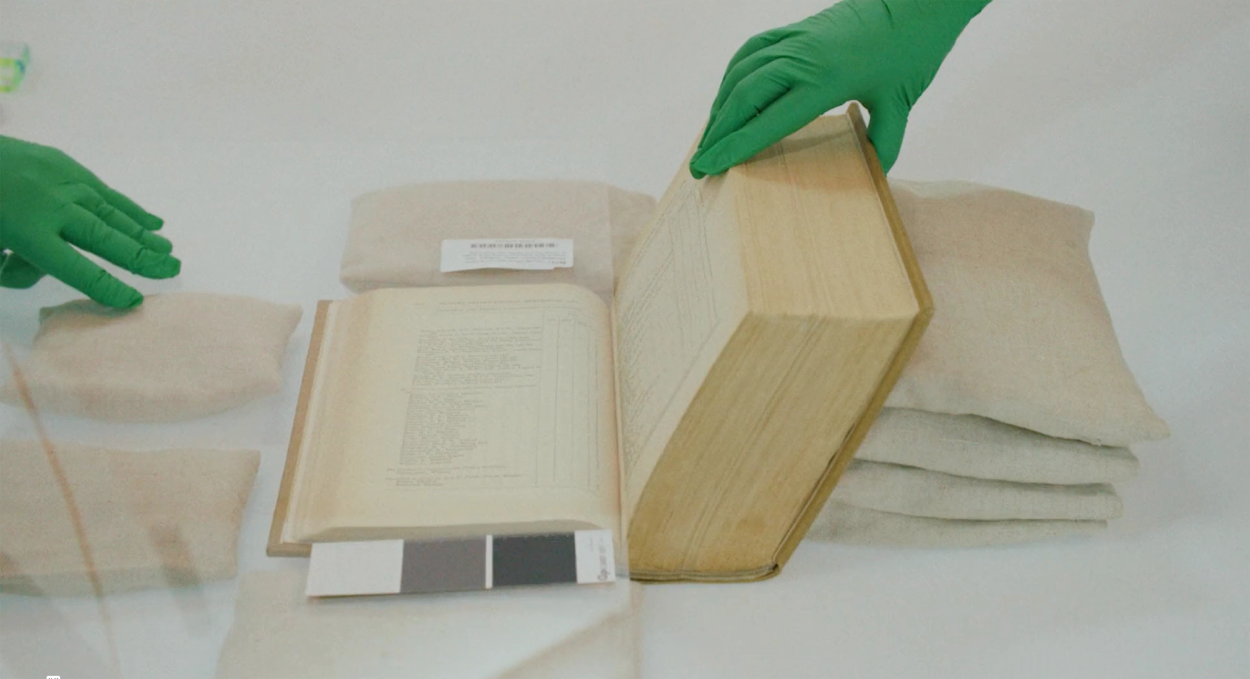
They were typically made by women who had obtained obsolete suiting samples from travelling salespeople or local stores. The maker of this rug, Clare Terrill nee Chamberlain, used samples cut from the swatch books passed on through family members from Richardson's department store in Armidale, New South Wales. She sewed these to a large piece of hessian. Chaff or flour bags were often used for the backing. There is little evidence that this rug was ever used. It may have been made as a contingency or simply because the suiting were readily available. While some makers used the different colours and textures of the suiting samples to create effective designs, the patches on this rug appear to be randomly selected and sewn in simple straight lines. The particular significance of this example derives from its association with the swatch books used by Clare Terrill, also acquired by the museum.
The simple design of this quilt exemplifies the utilitarian function of the bush rug or wagga. The patches are sewn into eight lines. Despite the fact that Clare was a very competent needle worker, as a girl she won first prize for a pair of drawers exhibited at the Armidale Show in 1911, the positioning of the various tones of brown, blue and grey does not suggest an intentional pattern.In this respect it differs markedly from the contemporaneous wagga made by Caroline West near Trundle, 85/371.
The term wagga rug is also applied to these quilts, although there is some debate over the appropriateness of its usage (see Jennifer Isaacs, The Gentle Arts, Sydney 1991, p.78). Originally made from hessian or flour sacks, the wagga derives its name either from the wheat growing centre of Wagga Wagga in southern New South Wales or bags used for the related brand of flour, 'wagga lilly'. The term was in common use by the 1900s.
The simple design of this quilt exemplifies the utilitarian function of the bush rug or wagga. The patches are sewn into eight lines. Despite the fact that Clare was a very competent needle worker, as a girl she won first prize for a pair of drawers exhibited at the Armidale Show in 1911, the positioning of the various tones of brown, blue and grey does not suggest an intentional pattern. In this respect it differs markedly from the contemporaneous wagga made by Caroline West near Trundle, 85/371.
There is little indication that this quilt was actually used as a rug. The hessian backing is in near pristine condition. The Chamberlain's had a particular dislike for discarding things, for reasons of utility or sentiment. Other objects in this collection, such as the 19th century children's clothes and cotton reel, evidence a desire to retain objects with particular associations. Objects relating to needlework seem to have had a particular significance for the Chamberlain women. Bruce Cady, friend of both Vere and Clare at the time of their deaths in 1989 and 1991, respectively, noted that Clare's house contained many items, such as the old buttons and needlework books in this collection, that had been kept by the sisters for future possible use.
The swatch samples, from which this quilt was made, were acquired from Richardson's Department Store by Clare Terrill (nee Chamberlain). Clare worked at the store in the 1920s and there met her future husband, James Terrill who was the store's accountant. They married in 1927. Clare's nephew, Ray Jopson, also worked for the store.
Lee and Dora Chamberlain migrated to New South Wales with their 10 month old baby Ada in 1888. They settled in the Armidale area shortly after arriving and had five more children - two boys and three girls. Only the girls survived: Vere b.1897; Clare b.1900; May b.1902. The first daughter Ada married and gave birth to a boy, Ray Jopson, in 1908. She died shortly afterward and Lee and Dora brought up their grandson as the son they had never had.
In 1912 the Chamberlains bought a block of land at 63 Barney Street, Armidale and Lee built a house which they called 'Richmond' after the Surry town where Dora and Lee had married in 1886.
Clare left home after marrying Jim Terrill in 1927 and lived nearby. Vere lived with her parents at 'Richmond' and remained unmarried in the family home after her father died in 1940 and her mother in 1959. Her sister Clare visited her regularly there until her death at the age of 91 in 1989. Clare died in 1991. They left no family and the contents of the house were disposed of by a family friend who passed on several items, including everything in this collection, to the donor who also befriended the sisters in their later years. He subsequently offered items to the Powerhouse Museum.