

Object statement
Weldon range finder with pouch, metal / leather, maker unknown, used by Leo Arthur Cotton, Shackleton's British Antarctic Expedition and University of Sydney, New South Wales, Australia, 1907-1948
This is a Weldon range finder, a hand-held optical scientific instrument used to measure distance from its position to a target point. It was primarily used by the military in the late 19th and early 20th centuries.
This instrument was owned by the Australian geologist, Leo Arthur Cotton (1883-1963). It is believed Cotton used this range finder while on Sir Ernest Shackleton's 1907-09 British Antarctic Expedition on board the "Nimrod". Cotton travelled to Antarctica as a young 24-year-old student, together with Douglas Mawson, and their former lecturer the prominent Australian geologist, Professor Edgeworth David. Cotton went on to become the Professor of Geology at The University of Sydney between 1925 and 1948.
Many different types of range finder have been devised for military use. It was devised to assist the gunner and infantry soldier to determine the distance or "range" to the objective. This one had been invented by a Madras Army officer from British India, Colonel Weldon, in about 1881 and is known as a Weldon coincidence type range finder, telemeter or position finder.
This instrument is of great significance illustrating the scientific work undertaken by Australian geologists in Antarctica.
Margaret Simpson
Curator, Science, Technology & Industry
December 2011.
McGraw Hill Encyclopaedia of Science and Technology, p.185.
The National Archives, UK. http://www.nationalarchives.gov.uk/a2a/records.aspx?cat=059-iorlmil_3-2_1-1&cid=1-1-21#1-1-21
Scientific American Supplement Volumes 1891-1898 http://chestofbooks.com/crafts/scientific-american/sup7/Weldon-s-Range-Finder.html
"Description and instructions for use of Weldon range finder", revised March 1, 1906, revised February 1, 1909, United States Army Ordnance Dept.
'Honour to Whom Honour Explorers Disclaim Credit' in "The Sydney Morning Herald" 19 April 1909, p.7.
Nairn, Bede, 'Cotton, Frank Stanley (1890-1955)', Australian Dictionary of Biography, National Centre of Biography, Australian National University, http://adb.anu.edu.au/biography/cotton-frank-stanley-6326/text9815, accessed 31 January 2012.
http://en.wikipedia.org/wiki/Cotton_Glacier
http://en.wikipedia.org/wiki/Olive_Cotton
Virtually all range finders operated as an angle measuring device for usually solving a right angle triangle.
This range finder was invented by an officer in the Madras Army, in British India, Colonel Weldon, by 1881. It was apparently patented by him in 1885 and sent by the British military to be tested in India and issued to British regiments there in 1887 for trial and report. However its issue was suspended in 1888. Improvements were then made to the range finder as reported in the "Scientific American Supplements" 1891-1898. Various types were manufactured. Some were in the shape of a fob watch with a swivelling centre section with only two prisms.
This three-prism Weldon range finder used the first and second prisms together to work out the range equal to 50 times the base. When the second and third prisms were used together the range was equal to four times the base; when the second and third prisms and the first and second prisms were used together the range was equal to 200 times the base; and when the second prism alone was used the range was 25 times the base.
To use the instrument the observer stood so that the range of the object being determined was on the user's right hand side and looking into the left-hand corner of the first prism the object was viewed there by double reflection. At the same time the observer looked through the opening in the lid below the prism and selected an object which appeared nearly in line with the image seen in the prism. He then shifted his position until the two images coincided. Lines drawn between the user and the two objects made right angles with each other. The observer then marked the position on the ground and shifted the instrument and looked into the left hand corner of the second prism and saw the image of the object whose range was required in double reflection which lay to the right of the object. Basic trigonometry was used to calculate the range.
Greater accuracy could be obtained by using the second prism only which was used for predicting the range of moving objects where three observers were required, two with range finders and another who measured the distance between the two.
The range finder could also be used as a depleidoscope (an instrument used to determine true noon) for transit observations. When it was used for this purpose the range finder was mounted on a block of wood with an elastic band and made level using the bubble level.
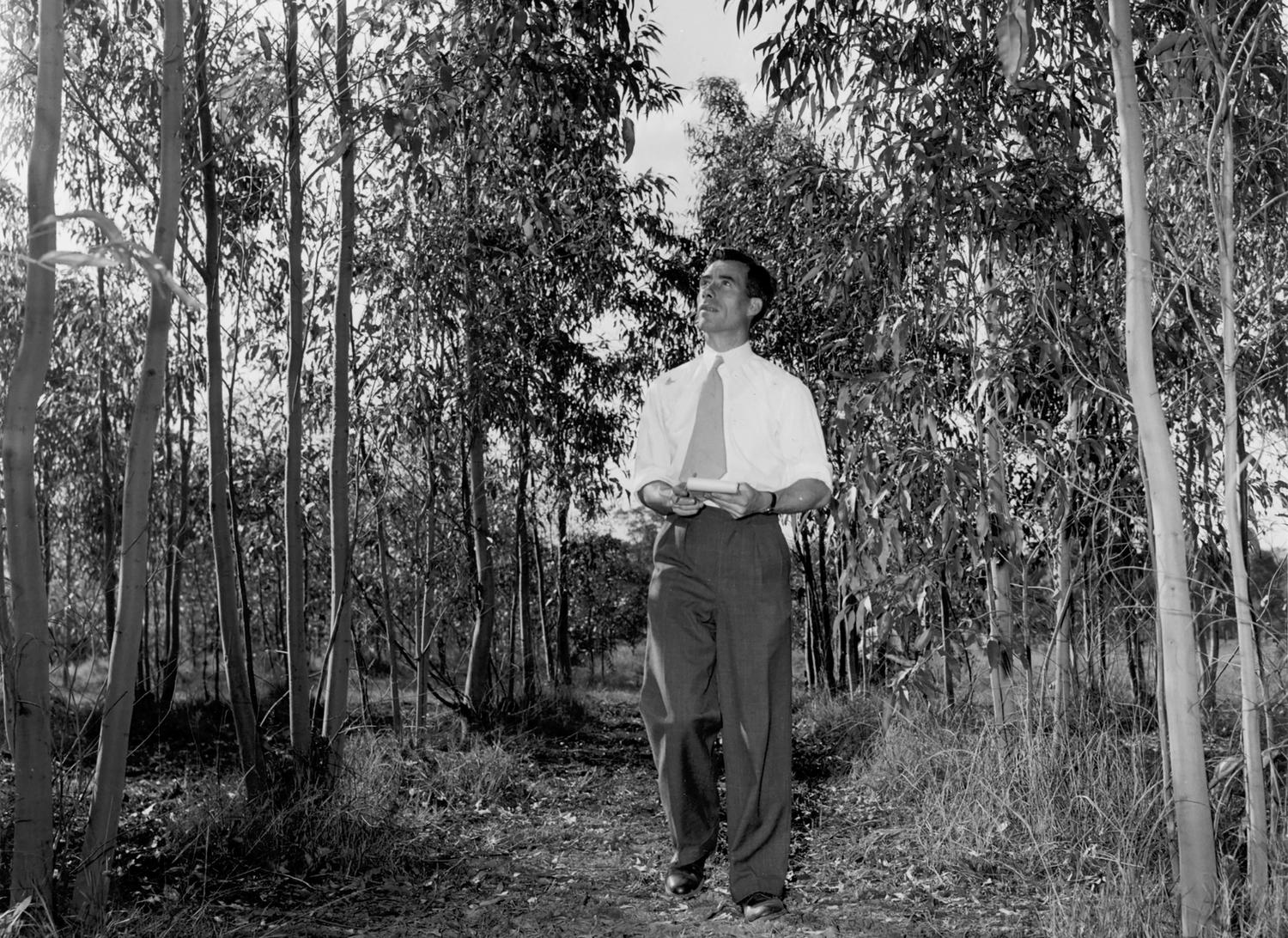
This Weldon range-finder was used by the Australian geologist and Antarctic expeditioner, Leo Arthur Cotton. Born at Nymagee, New South Wales, in 1883, Leo was the eldest son of Francis Cotton, a journalist and politician. He was educated at Fort Street Model School and in 1902 became a draughtsman in the Department of Lands in Sydney undertaking his Arts degree at the University of Sydney at night, graduating in 1906. He went on to a obtain Bachelor of Science degree.
Cotton travelled to the Antarctic, for the voyage only, with Ernest Shackleton on board the "Nimrod" which left from Lyttleton, New Zealand, in December 1907. It is believed that this Weldon range-finder many have been used by Cotton on the voyage down and in the Antarctic. At the time Cotton was a 24-year-old Sydney University geology demonstrator and travelled with Douglas Mawson and their former lecturer the prominent Australian geologist, Professor Edgeworth David. Cotton and Mawson were chosen from 470 applicants for the adventurous voyage. Cotton was selected because he had proven to be a "strong and enduring worker in Kosciuszko" (the highest mountain in Australia). On the expedition, Cotton was a meteorological observer and would have helped unload the equipment from the "Nimrod" and probably build the hut at Cape Royds, overlooking McMurdo Sound.
On his return to Australia in 1908 Cotton went back to the University. Mawson, who had been a lecturer in geology at the University of Adelaide, stayed on in Antarctica with Shackleton's party and discovered the South Magnetic Pole with Edgeworth David and Dr Alistair Forbes McKay in 1909.
In 1909 and 1910 Leo Cotton was awarded the Macleay Fellowship in Geology. In 1910 Cotton married Florence Edith Channon in Hornsby, on the northern fringe of Sydney, and the following year their first child, a daughter, Olive, was born who went on to become a famous photographer.
Professor David was Cotton's teacher and mentor and, while David was away during World War I, Cotton was acting head of the University's Geology Department. In 1920 Cotton became an assistant professor and in the same year was awarded a Doctor of Science and the University Medal with his thesis on earthquake frequency. In 1925 he succeeded David in the chair of geology and until 1948 was the Professor of Geology and Physical Geography. He was regularly quoted in the press commenting on earthquakes and tremors and in 1947 the likelihood of sea levels rising after a Swedish scientist noticed polar ice melting in the Arctic. His main research fields were isostasy (the structure of the earth's crust), diastrophism (the action of forces which have deformed the earth's crust), polar wanderings and the strength of the earth's crust. Cotton retired in 1948 and died in the northern Sydney beach suburb of Newport in 1963.
A glacier in Antarctica was named after Cotton by the Australian geographer, Thomas Griffith Taylor (1880-1963), on Robert Scott's British Antarctic Expedition of 1910-1913. The Cotton Glacier is about 18 km long and located on the south side of Clare Range in Victoria Land. Furthermore, the geology department of the University of New England at Armidale, New South Wales, was also named after him.
This Weldon range-finder as well as several other scientific instruments and photography equipment belonging to Leo Cotton and Professor David were handed down the Cotton family line and donated to the Museum by Leo Cotton's grandson, Malcolm Cotton.