




Object statement
Collection of items from Yap, Micronesia; stone money, woven bag, tortoiseshell bracelet, Japanese souvenir book of Yap, German postcards of Yap; collected by Andries ten Pas (1893-1957) while living and working in Yap, 1913-1915
These items are significant as relics of a life lived during an important and tumultuous era in the Pacific region, as major powers embroiled in two World Wars separated by the Great Depression sought to gain or maintain control of territories in the Pacific.
The Dutch postcards and Japanese photographs reflect the external influences that ebbed and flowed while the local culture remained constant, as represented by the stone coin, woven bag, and tortoiseshell bracelet.
The stone coin is particularly significant as an ethnographic artefact from a relatively under-studied culture, and is a numismatic curiosity representative of the difference between the indigenous and Western cultures that came together on the island of Yap. Regarding the ethnographic aspect, Quiggin (1978, 137) relates that: "Generally speaking the islanders needed no money; they were self-supporting and self-sufficient. There was little specialization in industry and no development of luxury objects. Nevertheless, on Yap money played a large part. As far as the necessities of life are concerned, food, shelter, and clothing are abundantly provided by nature and man has enough for his needs. But if he wants to get a wife, to found a family, and to become a member of the community, he must have money or the local equivalent of it. Marriage can only be achieved by payments and interchange of objects of recognized value; these are essential in social life from birth to death; and the existence of the community depends on the wealth of the heads of families which compose it. On Yap, therefore, which lies in so favourable a position in the Western Carolines [Micronesia], currency developed in many forms with a highly complicated monetary system".
Harrison Jones, volunteer, per Paul Donnelly, curator (28/09/2011)
/1 For hundreds of years, stones were specially quarried on the island of Palau (about 400 miles south-west of Yap) and carried home on canoes by the Yappese, who were masters of navigation. The stones were used as a form of currency among the Yappese, and the hardships endured during these voyages increased the value of the stones. To this day, these stones indicate the status and wealth of the tribal villages and are occasionally still being used for major transactions such as payment for a dowry or purchase of land.
Quiggin (1978, 144-146) writes: "The stone-money of Yap is the best known of all the 'curiosities of currency' though the largest specimens are necessarily absent from museums. The circular wheels or mill-stones, called 'fae' or 'palan', are made of a kind of limestone (aragonite) and vary in size from a few inches to 10 or 12 feet across. The rock is found on Babelthuap and other islands in the Pelews some 400 miles away, and the quarried stones are ferried across on rafts to form the Yap currency. Each stone has a hole in its centre so that it can be carried on a pole. [Â?] It is not only the size that counts. Much depends on whiteness and on shape, and certain old stones are more highly prized than new. [Â?] In earlier days the method of obtaining the stones was for the chief of a Yap village to give permission to a number of youths to go over to the Pelews and bring back a hundred or more stones, some large ones among them Â? The larger stones would very rarely be parted with, their chief value being the prestige acquired by the possessor Â? Having acquired the stones, they began to gamble with them. Alliances could be made, neutrals won over, wars begun and ended by means of stone-money." (Quiggin, AH, 1978. "A survey of primitive money: the beginnings of currency", London: Methuen & Co Ltd)
/2 This woven bag is typical of Micronesia handicrafts, and is an example of what is called an "alele" in the language of the nearby Marshall Islands (Mulford, J. 2006 "Handicrafts of the Marshall Islands", Marshallese Ministry of Resources and Development). The bag is made of plaited and folded pandanus leaves, and was traditionally used to store necklaces and tools.
/3 Tortoiseshell has long been considered an important ornamental material in Micronesia, having been one of the major exports since the beginning of systematic long-distance trade in the late 18th century when Chinese traders brought Western goods such as cloth and iron to the islands (Hezel, F. 1984. "A Brief Economic History of Micronesia." Past Achievements and Future Possibilities, Majuro: Micronesian Seminar). The material was used locally for jewellery and ornaments, and even for small plates and dishes in the homes of high-status families (p.210; Phelps, S. 1976. "Art and Artefacts of the Pacific, Africa and the Americas", London: Hutchinson & Co).
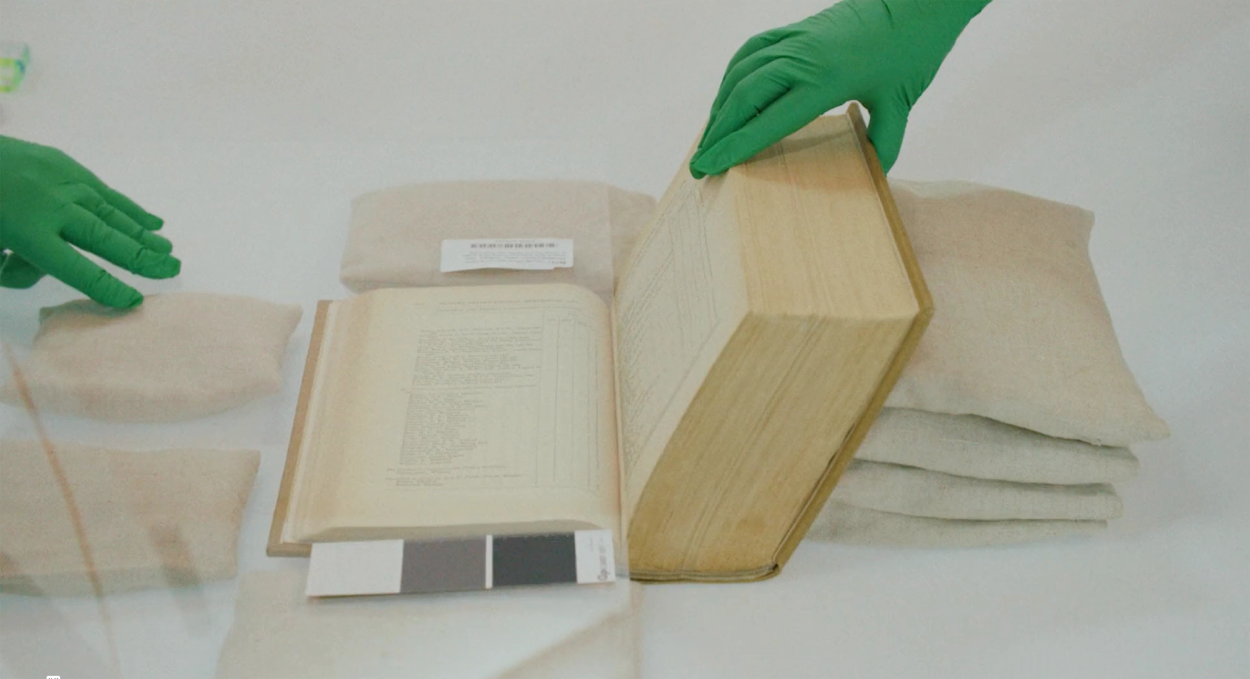
/4 This book of photographs depicts the island of Yap during the Japanese occupation, and therefore must have been produced sometime after October 1914 when the Japanese Expeditionary Squadron seized the islands from German control.
/5 These postcards show the people and landscape of the island of Yap under German control (1899-1914). Germany purchased the island group of Micronesia (also known as the Carolinas) in 1899 from Spain, who had explored the region from the 17th century and formally annexed the islands in 1874.
Harrison Jones, volunteer, per Paul Donnelly, curator (28/09/2011)
These items were collected during the period of 1913-1953 by Andries ten Pas in the course of his career and life in Yap, Micronesia. They were donated to the Powerhouse Museum in 2011 by his son, Andrew ten Pas.
Andries ten Pas was born in 1893 in the city of Zutphen in eastern Holland. Having graduated from high school in 1912 and trained as a telegrapher in Germany in 1912 and 1913, he was sent to Micronesia as a telegraph operator in the Niederlaendische-Deutsche Telegraphgesellschaft; his first posting was at the major cable station that the company had built on the island of Yap as a transfer and relay station between Asia, the Americas and the Dutch East Indies. Following the Japanese occupation of Yap in 1914, ten Pas moved to the Dutch East Indies (Indonsia) for several years before returning to Holland and joining a Dutch trading company "Internationale Handels en Crediet Vereniging Internatio" as a salesman.
In his new job, ten Pas worked in Japan, China, and again in the Dutch East Indies where he met Elisabeth de Lange, whom he married in 1925. In 1931, ten Pas lost his job due to the Great Depression and returned to Holland, but returned to the Dutch East Indies and the trading company the following year. In 1940 he retired and planned to move to Holland, but this proved unwise in the face of German invasion; he therefore remained in what seemed to be the much safer Dutch East Indies, but the Japanese invaded and occupied the territory in 1942. Having spent the rest of the war in a Japanese concentration camp, ten Pas worked for the Dutch colonial government until 1949 when he returned to Holland. After a brief return to Jakarta to work for the trading company, he finally retired to Holland in 1953 where he died in 1957.
Harrison Jones, volunteer, per Paul Donnelly, curator (28/09/2011)