

Powerhouse Museum Collection Search 2.53
Category history:
   

Support the Powerhouse with a tax-deductible gift

Make a donation

Make a donation

Make a donation
This object belongs to
Representations of Registered Australian Designs, 1919 - 2002

No image is publicly available for this object.

Because of the age of the Museum's collection some objects in the Museum's collection have not yet been digitised. Some images are not available for Copyright reasons. Some images are not available for cultural or privacy reasons.

Object statement
Archive, 'Representations of Registered Australian Designs', Intellectual Property (IP) Australia / Australian Industrial Property Organisation (AIPO) / Patents, Trade Marks and Designs Office, Sydney, New South Wales, Australia, 1919-2002
This archive represents a record of design activity in Australia over almost a century. It documents a history of designs registered in Australia by Australian and international companies from 1919-2002. The designs are for manufactured articles including domestic products, textiles, furniture, toys and other products that were intended for sale in Australia. The products were designed in Australia and overseas and deemed significant enough by the applicants to afford design protection in Australia.

These paper records were held by the IP Australia NSW Office in Sydney and used by members of the public prior to applying for a design registration. They have been replaced by an online database for searching designs from 1985 onwards. The process of prior art searching before applying is necessary to determine if a design is new and original and therefore suitable to register. By registering a design an applicant obtains exclusive use of the design for a period of time. In 2003 the Australian design legislation was updated and prior art expanded to include not only designs that had been used in Australia but also those that had been published anywhere in the world. This change reflects the increased global exchange in design and manufacturing and the importance of intellectual property to business and trade. These records represent one important part of the process of obtaining design protection in Australia.
When applying to the Patents, Trade Marks and Designs Office for a design registration, applicants submitted seven copies of their application which were distributed to all state offices and the central office. The records of representations of designs were available in each office for members of the public to search prior to applying for a design registration.

These paper records were held by the IP Australia NSW Office in Sydney for public access. The records from the IP Australia central office in Canberra are preserved by the National Archives in Canberra and some duplicates are also held in the Brisbane office of National Archives and possibly also in other State offices of IP Australia.

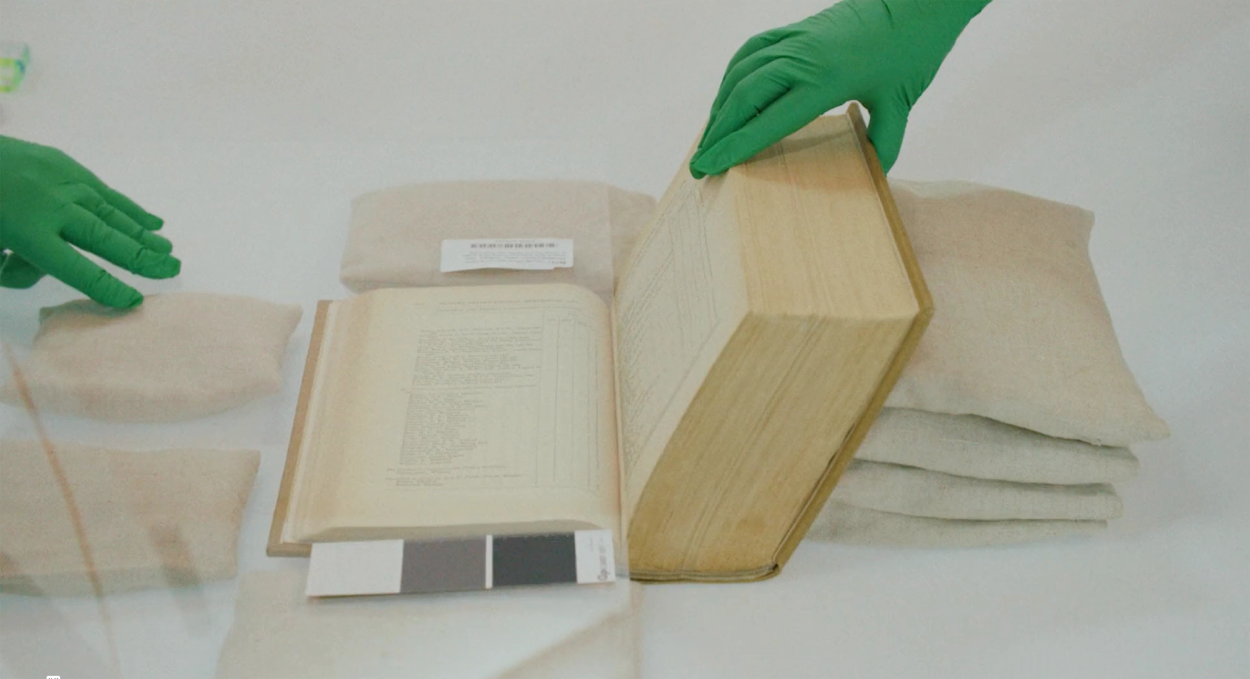
Bound volumes from 1919 to mid-1970s consist of approx 350 volumes. They include designs for mechanical devices, consumer and domestic products, bicycles, cars, toys, furniture, decorative arts, dinnerware, ceramics, clothing, accessories and apparel registered in Australia by both Australian and international companies. They are organised by class (product category) and in order of application number/date. Each form shows; name of applicant, number of application, date of application, articles in respect of which registration is applied for, class number, representation of design, statement of nature of design, and signature of applicant, or of his agent. Where applicable, date of expiration of registration and extension period of registration is also shown. Many of the forms are printed copies but blue prints and photostat copies are also included. The representations of the design are in the form of drawings, sketches, photographic prints and sample specimens (mostly fabric but some are metal or plastic).

The bound volumes from 1974 - 1982 are also organised by class and contain photographs (colour and B&W), drawings, fabric samples and some metal and plastic product samples. Fabrics are sometimes represented by colour photographs. There are some quite large fabric samples, for example an entire folded tea-towel.

The newer bound folders 'Registered Australian Designs' begin from 1982 and are organised by design registration number, not date. These records contain sketches, photographs (colour, B&W and photocopies). Few fabric samples are present. Towards the late 1990s the records are photocopies and contain only one main image on a single page.

From design registration number 90000 onwards (lodged in 1983 and granted in 1985) the records are available online through the IP Australia website (http://www.ipaustralia.gov.au/designs). Selected design registrations from 1973 to 1985 are also online, but only those that were still valid in 1985. These design registration records will remain online indefinitely. Over the last 17 years about 65% of designs registered in Australia have been by Australian organisations.

Microfiche copies of designs from 1906 to 1998 (some earlier back to 1899) are also included and were used as the first point of searching. Leather bound volumes of designs from 1906 - c1918 are held by the IP Australia NSW Office.

According to the IP Australia website the design is the overall appearance of a product. The visual features that form the design include the shape, configuration, pattern and ornamentation which, when applied to the product, give it a unique appearance. A registered design can be a valuable commercial asset - registration of a design gives the owner protection for the visual appearance of the product but not the feel of the product, what it is made from or how it works. To be registrable, a design must be new and distinctive. 'New' means the identical design (or one very similar) has not been publicly used in Australia nor has it been published in a document within or outside Australia. A design is 'distinctive' unless it is substantially similar in overall appearance to other designs already in the public domain. Applicants are advised to search past design registrations to ensure their design is new and distinctive.
Sourced from
IP Australia, 'What is a design?', IP Australia website,
http://www.ipaustralia.gov.au/designs/what_index.shtml [accessed 25 Oct 2006]

Note on the classifications/classes of designs.

From 1907 these designs were classified according to materials used in the design, but in the 1980s-1990s? the classifications changed to the type of article, product or application and now reflect the Locarno International Design Classifications (IDC).

From 1907 to 1980s the classes were as following:
Classes
1. Articles composed wholly or chiefly of metal, not included in Class 2.
2. Jewellery.
3. Articles composed wholly or chiefly of wood, bone ivory, papier. mache, or other solid substances not included in other classes.
4. Articles composed wholly or chiefly of glass, earthenware, or porcelain, bricks, tiles or cement, but not including articles comprised in Class 4A
4A. Articles for household use composed wholly or chiefly of glass, earthenware, or porcelain.
5. Articles composed wholly or chiefly of paper (except hangings).
6. Articles composed wholly or chiefly of leather, including book bindings, of all materials, but not included ladies handbags and ladies belts.
6A. Articles composed wholly or chiefly of leather, being ladies handbags or ladies belts.
7. Paper hangings.
8. Carpets and rugs in all materials, floorcloths and oilcloths.
9. Lace, hosiery.
10. Millinery and wearing apparel, including boots and shoes.
11. Ornamental needlework on muslin nor other textile fabrics.
12. Printed or woven designs on textile piece goods.
13. Printed or woven designs on handkerchiefs and shawls.
14. Articles not included in other classes.
This list is from Designs Regulations 1980, but it is the same as Designs Regulations 1907 with the exception of 4A and 6A.

The Locarno Classification is based on a multilateral treaty administered by the World Intellectual Property Organisation (WIPO). This treaty is called the Locarno Agreement Establishing an International Classification for Industrial Designs, which was concluded in 1968.The Locarno International Design Classification (IDC) comprises a list of 32 classes and 223 subclasses with explanatory notes and an alphabetical list of goods in which industrial designs are incorporated, with an indication of the classes and subclasses into which they fall. In order to keep the Locarno Classification up to date, it is continuously revised and a new edition is published every five years. The current (eighth) edition has been in force since January 1, 2004. A list of the current IDC can be found at http://www.wipo.int/classifications/fulltext/locarno8/enlnot.htm [accessed 6 November 2006]
These records were offered to the Museum when the IP Australia NSW Office relocated in November 2006 from Clarence St Sydney to smaller offices at the Australian Technology Park in Redfern.

The Australian patent system is derived from the British system as British Law, and hence British patents, originally extended to Australia. As the various States of Australia became independent each developed its own Patents Act. With Federation in 1901 the Australian Constitution gave the Federal government power over copyright, patents, trademarks and designs. The first Federal Patents Act was passed in 1903 and the Patent Office opened in 1904.

The Sydney Sub-Office of the Patents and Trade Marks, Copyright and Designs Office, renamed from about 1969 the Patents, Trade Marks and Designs Office, is first listed in Sydney directories from February 1910. The Office was responsible for accepting applications for Trade Marks and Designs, and until 1968, for Copyright. Patent applications could be lodged in Sydney as well as in Canberra. In 1992 the Office was incorporated into the Australian Industrial Property Organisation (AIPO) and in 1998, AIPO officially launched its new name, IP Australia.

Design protection became important when mass production of articles began after the Industrial Revolution. Statutes protecting the novelty of designs began in England in the late 1700s. They were initially applied to textiles and later developed to cover the ornamentation, shape and configuration of articles of manufacture.

In Australia the Designs Act 1906 (Cth) established a system for the registration of new or original designs for the visual appearance of commercial products. The design monopoly lasted for up to 16 years and protected the appearance of an article to which a distinctive shape, ornamentation or pattern could be given. The appearance of a whole range of articles from cars to toys to furniture were protected by the Act. In 1995 the Designs Act 1906 (Cth) was reviewed by the Australian Law Reform Commission and the recommendations led to the introduction of the Designs Act 2003. The new act came into force in June 2004 and the key features included a more streamlined registration process; better enforcement and dispute resolution procedures; stricter eligibility and infringement tests; and clearer definitions. Design registrations continue to be assessed against designs used previously in Australia but the prior art base has been expanded to include designs that have been published anywhere in the world. Design applications now only undergo a formalities check prior to being registered as there is a system of post-registration examination for substantive issues. Design protection now lasts for a maximum of ten years.

References

IP Australia, 'New Designs', IP Australia website, http://www.ipaustralia.gov.au/new_designs/index.shtml, [accessed 31 October 2006].

McKeough, J. and Stewart, A., 'Intellectual Property in Australia', 2nd Ed, Butterworths, North Ryde, 1997.

National Archives of Australia, Agency notes for agency CA 8561, IP Australia.

National Archives of Australia, Agency notes for agency CA 898, Patents, Trade Marks and Designs Sub-Office, New South Wales.

Old F, 'Inventions, Patents, Brands and Designs', Patent Press, Killara, 1993.

 This text content licensed under CC BY-NC.

Description
Archive, 'Representations of Registered Australian Designs', Intellectual Property (IP) Australia / Australian Industrial Property Organisation (AIPO) / Patents, Trade Marks and Designs Office, Sydney, New South Wales, Australia, 1919-2002

The records are in the form of bound paper volumes of 'representations of designs' from 1919-2002. The bound volumes include designs for mechanical devices, consumer and domestic products, bicycles, cars, toys, furniture, decorative arts, dinnerware, ceramics, clothing, accessories and apparel registered in Australia by both Australian and international companies. Each form shows the details of the applicant and the design and includes a representation of the design in the form of drawings, sketches, photographic prints or sample specimens (mostly fabric but some are metal or plastic). Many of the forms are printed copies but blue prints and photostat copies are also included.

Copies of the annual 'Index to registered owners of designs' from 1969-1979 and microfiche copies of the designs from 1906 to 1998 are also included.
Made: Commonwealth Patents, Trade Marks and Design Office; Sydney, New South Wales; 1919 - 2002
2006/160/1
Production date
1919 - 2002

 This text content licensed under CC BY-SA.
This object belongs to:
IP Australia Archive Collection
Subjects
+ Australian product design
+ Australian design
Short persistent URL
Concise link back to this object: http://from.ph/363136
Cite this object in Wikipedia
Copy and paste this wiki-markup:

{{cite web |url=http://from.ph/363136 |title=Representations of Registered Australian Designs |author=Powerhouse Museum |accessdate=24 May 2013 |publisher=Powerhouse Museum, Australia}}


Copyright
Images on this site are reproduced for the purposes of research and study only. Whilst every effort has been made to trace the Copyright holders, we would be grateful for any information concerning Copyright of the images and we will withdraw them immediately on Copyright holder's request.
Object viewed 2363 times. Parent IRN: 2130. Master IRN: 2130 Img: Flv: H:px W:px SMO: RIGHTS:.