Object statement
Sculptural form, 'Light Well', cast glass, hand-carved and hand-polished, made by Richard Whiteley, Canberra, Australian Capital Territory, Australia, 2003
This sculptural form, 'Light Well', was designed and made in 2003 by Australian glass artist, Richard Whiteley (b. 1963). It was one of seventeen pieces to feature in his solo exhibition, 'Refraction', at Axia Modern Art gallery in Melbourne. Whiteley's work consists of solid, coloured cast glass structures through which he explores the refraction and reflection of light and the optical manipulation of space formed through both the casting process and the surface treatment of the forms.
From the early 1970s, the development of studio glass in Australia (that is, glass made by artists in studios other than in industry) has largely focussed on glass-blowing, kilnforming of flat and mosaic glass, lead-lighting and stained glass. Some people have worked with cast glass, but these have mostly been small in scale or made in sections. Richard Whiteley's large forms are a major innovation in this area, as he has had to develop different technologies (working with adaptations of stone-mason's technologies) to enable him to work on the surfaces of such large pieces. In form and scale, they are perhaps most close to the work of Czech artists, Stanislav Libensky and Jaroslava Brychtova (represented in the collection with a work of the early 1980s), although these artists were able to work with industry facilities.
Recently appointed in late 2002 as the head of the glass workshop at the Canberra School of Art at the Australian National University, Richard Whiteley (b.1963) became involved in glass making in 1980 when he apprenticed himself to leadlight artist, Robert Clark, in Melbourne. He studied first in Australia (graduating 1987) and later in the USA (graduating 1993). He has exhibited in Australia since 1988 and in the United States since 1993, and has taught in Japan as well as Australia and the United States. In 2000 he was the winner of the prestigious RFC (now Ranamok) Glass Prize in Australia and he has received a number of research grants, the most recent being an Australia Council individual project grant in 2001. In both 2001 and 2002 he was commissioned to make 7 major and 13 small pieces for the Australian Business Art Foundation Awards. Along the way he has been actively involved with the national organisation, Ausglass, has been chair of the Sydney-based organisation, Object: Australian Centre of craft and design, and from 1999-2001 was an international board member of the Glass Art Society (GAS), USA.
To a certain extent Richard Whiteley's forms draw on the casting and cold-working traditions of Czech glass, but he has had to develop a studio solution to working on a large scale rather than the industrial one that Czech artists enjoy, to resolve the construction and finishing of his pieces. His influences have been as broad as the different approaches of artists such as Klaus Moje in Australia, William Carlson in Illinois and the skilled laboratory technicians making reflecting mirrors for telescopes in the Mirror Lab at the University of Arizona. Canberra-based Moje, working with kilnformed cold-worked mosaic glass, instilled in him a respect for a materials-based approach to designing and making, within a school also strong in ideas and art history and theory.
Graduate school with William Carlson in Illinois, USA, expanded an approach to working in glass as contemporary visual art, where the concept behind the work took precedence over a materials or process approach to meaning. When Whiteley returned to Australia in 1994 it took 18 months to resolve a path for himself between these two approaches, and he realised he valued a hands-on involvement with materials in the development of ideas; he had 'missed the dialogue with materials'. He believes now that concepts and skills need not be considered as opposite poles in the development of meaning in a work, but that investigation and exploration take place as an inter-weaving between the two, or 'like a hand in a glove'.
It is not surprising that Richard Whiteley has resolved to work with reflected and refracted light through glass, in the way that he has. 'As a young kid I was an altar boy, and was aware of the visual power of church windows; I remember both the windows themselves and the coloured light they cast on the floor, as both an amazing experience and as illuminated stories.' When leadlight artist Robert Clark came to his high school in Melbourne in 1980, and gave a talk on the work of glass artists like Ludwig Shaffrath and others, he was very impressed, and at 16 years old apprenticed himself to Clark for three years. At one point Clark sent him off to an Ausglass conference in Melbourne where he quickly became aware of the diversity of practice and potential for what might be possible for him, and followed up with two years of night classes in stained glass with artist Klaus Zimmer at the Caulfield Institute of Technology.
Whiteley eventually enrolled with Klaus Moje in Canberra as an undergraduate in 1983, in the second year of the school's new glass course, also studying there over the years under artists like Neil Roberts and Elizabeth McClure, and now teaching with Jane Bruce and Kirstie Rea. From that time, casting has featured in his work at various points. As a student he worked in both casting and fused mosaic kilnforming, later making some cast and glued assemblages. In 1986 he worked with Czech artists Stanislav Libensky and Jaroslava Brychtova at Pilchuck, Seattle, and after graduation set up his own studio in Canberra in 1987. When he gained a scholarship to study in the United States in 1988 he put this area on hold for some time while pursuing ideas that incorporated printed visual and textual elements in the glass. Casting started again in Australia in 1995, where the piece he submitted to the RFC (Resource Finance Corporation) glass prize comprised high quality lead crystal blocks, each with a letter from the word 'transparent' silhouetted against the wall. With this work he rediscovered his fascination with the refractive properties of glass formed in this way.
Richard Whiteley joined Maureen Cahill at Sydney College of the Arts in 1994, and around the same time set up in a shared studio in Manly with Rob Wynne, Ben Edols and Kathy Elliott, Bettina Visentins, Matthew Curtis and others: 'These were very formative years,' he reflects. 'You learn a lot in a shared studio and working here was a pivotal experience. Sooner or later you have to start putting the rubber on the road in developing a professional practice and I was inspired by others who had shown confidence in making big decisions, sometimes completely changing direction.'
After nearly two years of experimentation in 1996-97, Whiteley showed new work in October 1998 at Craft Victoria in Melbourne, that demonstrated the direction his work was taking in cast glass. In 1999 he took the first of what he considers to be two large risks. The first was the major logistic and financial commitment of taking an exhibition to the 1999 GAS conference in Tampa, with Maureen Williams, Nick Mount and Robyn Campbell, supported by the Thomas Foundation and the Australia Council. As well as showing in their supportive galleries in Australia, they also wanted to start exhibiting in major American galleries. Whiteley was successful in showing his work at Heller Gallery and the Bullseye Connection Gallery, and also later at the Marx Saunders Gallery. The second move was to quit teaching in 2000 to work full-time as an artist for what became a two-year period. 'I wanted time to focus on getting closer to my work and to do more research; I needed different technologies and processes. My ideas and head are always a couple of years ahead of the process and I needed to find new ways of working to manage the larger forms and speed up the process.'
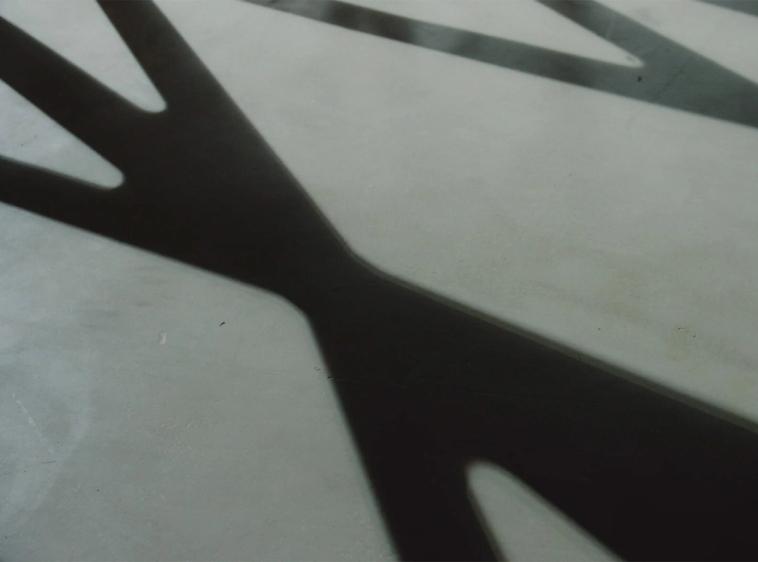
In the recent tall symmetrical lens forms he has been exploring or playing with the effects of variations of light, and how our attention shifts between the surface and interior of each work. While some of the internal optical shapes are made by inserting forms into the plaster casting mould, others that appear as internal planes are optical illusions, formed by the light working on the external facets of the works. He is also conscious of the effects of, and on, surrounding spaces: 'My interests in creating partial elliptical lens-like blades of glass that act as architectural devices for re-shaping and sometimes obscuring or redefining the surrounding space, have converged with the idea of contemplating the interior of the glass.' Outside his own field, some of those whose work interests him include sculptor Richard Serra, and architects Tadao Ando and Steve Holl, because they work with an understanding of their chosen materials to make strong simple forms in space.
While still geometric in form, new works are less symmetrical, more three-dimensional and with some folded and wrapped elements. Rich saturated colours contrast with, and complement, others of pale transparency. Whiteley says of where he is going at this point: He says (interview 2003): 'I like the idea of working with a raw quality in a precious refractive material and I like how the intensities of colour and tone can change the form so radically. I stay fascinated by the duality of the negative being seen as a positive both through the shapes buried within and through what happens within because of the external facets. While I can plan what I want by drawing the forms and making prototypes in polystyrene, it is not until the glass is cast and I start to work on it, that it is really possible to see how it works. It is then the light working with the glass that activates the vibrancy of the colour and defines the changing positive and negative nature of the shapes and planes.'
(Text from Grace Cochrane, 'Beyond Face Value', Craft Arts International No. 58, 2003)
Whereas Richard Whiteley previously made his own glass, he now uses, for different effects and purposes, Bullseye glass and Gaffer glass, and a glass manufactured in the Czech Republic. He is defining his own palette of colours, and has explored two-colour casting processes as well as techniques which combine colours in the cold-working stages of production. A large kiln allows a quicker process with more tests. Over recent years he has refined his cold-working processes, now working with the adapted technologies of stonemasons to carry out cold-working on a large scale: taking the tool to the piece, rather than the other way around. Now 100-kilo pieces of glass can be cold-worked much more quickly and effectively than before. For these developments he has formed new working relationships with suppliers who have taken an interest in the different characteristics of glass and who help find and adapt materials and tools that can improve the working process. His recent move to Canberra has meant the establishment of a new studio that looks and functions like a foundry, with machines and tools designed to give him maximum independence in production, and where he can explore ideas more freely and confidently.