



Object statement
Scrapbook, compiled by Mary Truby King (later Mary White), containing clippings of her own child care and mother craft articles in Australian women's magazines, together with associated correspondence, paper, Australia, 1928 - [2002]
This personal scrapbook belonged to a woman who, directly and indirectly, had an enormous influence on the way infants were raised throughout the 20th century in Australia and internationally. Mary Truby King helped to establish the Australian Mothercraft Society and the Karitane Products Society in Australia.
She also wrote for the Australian Women's Weekly for 4 years. Her magazine columns were wide-ranging, covering such topics as baby feeding and nutrition, general infant care, clothing and safety, the nursing of sick children, and toddler psychology. With titles like 'Over-stimulation is bad for baby', 'A plea for mother craft courses in our schools', 'Clothe your child suitably for the beach!', 'A few suggestions for the toddler's menu', and 'Ten of the reasons why baby cries!', they were often accompanied by photographs of 'bonny little Australians' 'brought up on the Truby King system' and by small advertisements for Mary's 'Mothercraft' book.
Born Esther Loreena Gordon in 1904, Mary Truby King became the adopted only child of the renowned child welfare expert, Dr (later Sir) Frederic Truby King and his wife Isabella ('Bella'). It was Frederic Truby King who founded the Society for the Promotion of the Health of Women and Children (later to be known as the Plunket Society) in 1907 in Dunedin, New Zealand. His vision of babies saved through the application of science to motherhood found wide appeal and his fanatical zeal saw his methods adopted not only in New Zealand but also in Australia and Britain. His book, 'Feeding and care of baby' (1913), became a virtual bible for many in infant welfare. Truby King's legacy, which persists to this day, is the doctrine of feeding by the clock.
It was because of Mary that Truby King had initially become interested in infant welfare. At the time when he and his wife took Mary in, Truby King was the medical superintendent of Seacliff Lunatic Asylum. Not satisfied with the child's progress, Bella asked her husband to design a better feeding formula for her. Truby King turned his attention from nutrition of animals on the hospital farm, to the feeding and care of human infants. The eventual result was the formal training of nurses in maternal and infant welfare, the opening of local clinics, the founding of a string of Karitane hospitals, and the development of commercial infant formulae for babies that could not be breast fed, manufactured by the Karitane Products Society Ltd.
When Mary grew up she trained as a kindergarten teacher and nurse and spent much of her early adult life as an assistant to Truby King. After her mother died in 1927, she took over as her father's mainstay and secretary. In 1930, at the age of 26, she moved to Australia on Plunket Society business and stayed here.
Bella King had, with her husband's oversight, written a popular column 'Our babies', which by 1914 appeared in 50 newspapers throughout New Zealand. Mary was to follow this path as well. From 1930 to 1934 Mary penned a regular column for The Australian Women's Mirror under the by-line 'A Mothercraft Nurse'. At around the same time she was broadcasting a weekly program on Radio 2UE in Sydney. Her regular Wednesday morning talk with Matron McLean from New Zealand on 2UE continued from 1932 to 1942. These chats may have become part of the 2UE Mothercraft Club, which was set up in 1934 by 'Auntie May', a pseudonym for Mrs Mabel Filmer. In 1934, with her father's help, Mary Truby King wrote a book called 'Mothercraft'. It was published internationally by Whitcombe & Tombs and ran to at least 16 printings.
In September 1933 articles 'For Young Wives & Mothers' began to appear in The Australian Women's Weekly, under her own name - 'Mary Truby King, Daughter of Sir Truby King, the World Famous Authority on Baby Welfare'. The Australian Women's Weekly was first published in June 1933 meaning that, by her own reckoning, Mary Truby King 'was writing for this magazine practically from its start'. Her last article was published in June 1937, so she had written 'a weekly article for nearly 4 years! (with a little time off for illness)'.
Mary evidently began her literary life writing under the pseudonym Molly Howden. A book of poems, 'Green violets', was published in 1928, and there were poems and articles by 'Molly Howden' or 'M.H.' in New Zealand Home Life and The Australian Woman's Mirror from at least 1928 to 1933.
In 1945 Mary married Tony White and settled into family life in South Australia, while continuing to write letters, stories and poetry. She had two sons, Stephen and Michael. After her husband died in 1997 Stephen lived with her until she moved to a retirement home. Mary White died in April 2002 aged 98 years.
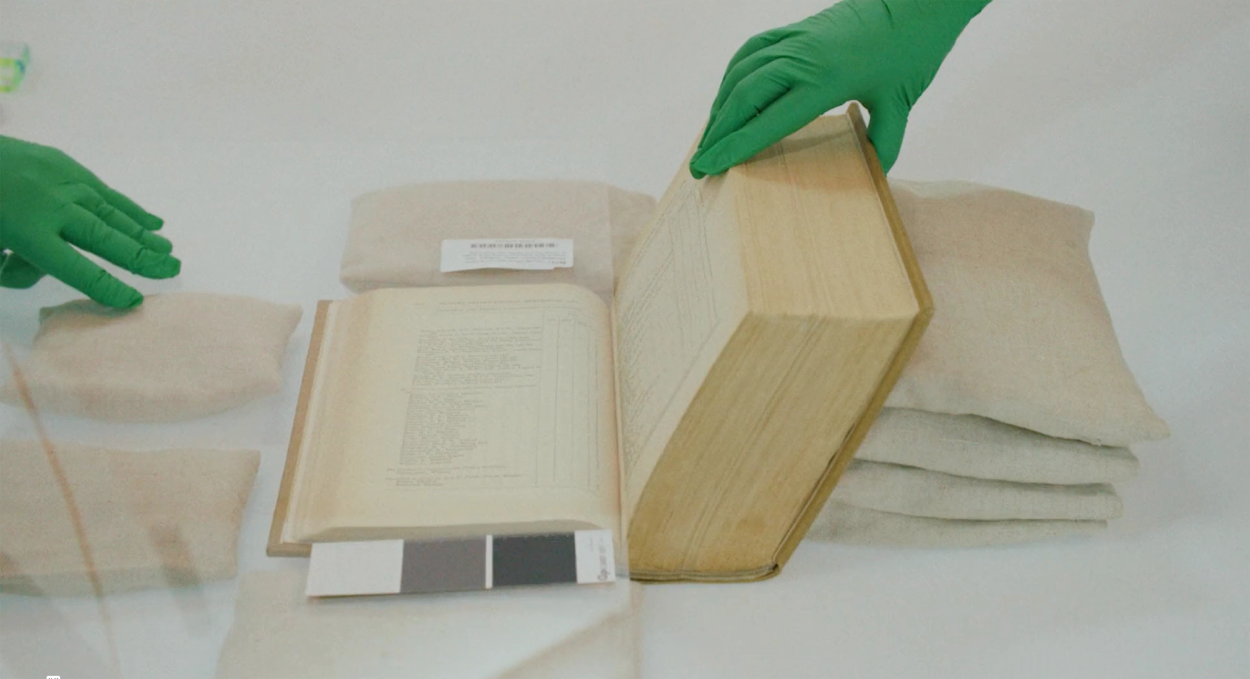
The scrapbook in the Powerhouse collection was compiled by Mary Truby King herself and contains clippings of her own articles from The Australian Woman's Mirror and The Australian Women's Weekly in the years 1930 to 1937. It has been indexed in her own handwriting and there are annotations, often relating to the payment she received. Inside the back cover is a handwritten note about her four years' involvement with The Australian Women's Weekly, presumably written more recently for Stephen's benefit. There are also some items of correspondence inside the book and loose clippings, including 'Mary Howden' poems and articles, and numerous newspaper reviews of her 'Green violets' poetry book.
Stephen White generously donated his mother's scrapbook to the Powerhouse Museum in 2003. It is a remarkable record of ideas, trends and practices in mothercraft and infant welfare in the early decades of the 20th century. Between them, The Australian Women's Mirror and The Australian Women's Weekly had an enormous and avid readership amongst women in Australia. Through her magazine columns and her other efforts in promoting her father's system, Mary Truby King had a lasting effect on the way children have been raised in Australia.
(Statement of significance compiled by Megan Hicks, curator of health and medicine, and Sharon Ganzer, University of NSW intern)
Sources:
Brookes, Barbara, King, Frederic Truby 1858 - 1938: bank clerk, asylum superintendent, child health reformer, Dictionary of New Zealand biography, 2002.
http://www.dnzb.govt.nz/dnzb/
O'Connor, Karen, Our babies - the state's best asset: a history of 75 years of baby health services in New South Wales, NSW Department of Health, 2000.
Reiger, Kerreen M., The disenchantment of the home: modernizing the Australian family 1880-1940, Oxford University Press, Melbourne, 1985.
Ruscoe, Joanne, Mary White obituary (press release), Plunket On-Line (The Plunket Society, New Zealand)
http://www.plunket.org.nz/Media_Releases/2002/Mary_White_Obituary.htm
Further reading:
Smith, P. M., 'Truby King in Australia: a revisionist view of reduced infant mortality', New Zealand Journal of History 22, No. 1 (1988), pp. 23-43.
Truby King, Mary, Mothercraft, Whitcombe & Tombs Ltd, Melbourne, 1934.
Truby King, Mary, Truby King the Man, London, 1948.
The scrapbook was compiled by Mary Truby King evidently in the 1930s and contains clippings, mainly of her own articles in The Australian Woman's Mirror and The Australian Women's Weekly, together with some items of correspondence. It has been hand annotated Mary Truby King (later Mary White) and there is also one hand annotation by her son, Stephen White, on the inside front cover.
The earliest items pasted in the scrapbook are dated 1928 and the latest are 1937. Mary Truby King probably compiled the book at around the time these articles were published or soon after. There is a hand annotation by Mary Truby King (Mary White) on the inside back cover that has apparently been made more recently, possibly for the benefit of her son, Stephen White. There is also a hand annotation by Stephen White on the inside front cover, possibly made for the benefit of the Powerhouse Museum before he arranged for the book to be given to the Museum some time after his mother's death in 2002.