Powerhouse Museum Collection Search 2.53
Category history:
   

Support the Powerhouse with a tax-deductible gift

Make a donation

Make a donation

Make a donation
This object belongs to
Trophies and Awards > Medallions

+ 2010/1/91 Nuclear Research Foundation me...
+ 89/411 Medallion, coated aluminium, comm...
+ 2012/72/1 Medallions with cases [2], sil...
+ 89/454-3 Medallion, Parramatta Philateli...
+ 85/992 Medallion, [plaque], Agricultural...
+ 87/1560 Medallions (2), gold-plated, Bic...
+ 87/1560-1/1 Medallion, Bicentennial, Aus...
+ 87/1560-2/1 Medallion, Bicentennial, 178...
+ 88/618 Medallion, Australia, [Tas] Comme...
+ 88/619 Medallions, (2), Australia, [WA] ...
+ 88/619-1 Medallion, circular, sterling s...
+ 88/619-2 Medallion, circular, sterling s...
+ 88/620 Medallion, Australia, Queensland,...
+ 88/622 Medallion, Australia, Commemorati...
+ 88/622-1 Medallion, Australia, Commemora...
+ 88/623 Medallion, Australia [NSW] commem...
+ 88/625 Medallions, (2), Australia [Norfo...
+ 88/626-1 Medallion, circular, gold plate...
+ 88/628 Medallions, (2), USA/Australian C...
+ 88/724 Medallions, (15), commemorative, ...
+ 88/732 Medallion and case, Sydney Intern...
+ 88/927 Medallions, (2), Commemorative/Bi...
+ 88/927-1 Medallion, aerial view Sydney h...
+ 88/927-2 Medallion, aerial view Sydney h...
+ 88/933-2 Medallion, Leeton High School, ...
+ 88/940 Medallion, religious, commemorati...
+ 88/942 Medallions, (2), commemorative, l...
+ 88/942-1 Medallion, antique silver/white...
+ 88/942-2 Medallion, antique copper...
+ 88/943 Medallion, commemorative: The Tas...
+ 88/944 Medallions, (2), Commemorative, 5...
+ 88/944-1 Medallion, fishing scene, wreat...
+ 88/944-2 Medallion, fishing scene, wreat...
+ 88/946 Medallion, commemorative, Correct...
+ 88/947 Medallion, commemorative, NSW Bic...
+ 88/949 Medallion, commemorative, Numisma...
+ 88/1060 Medallion, Bowral Horse Show Soc...
+ 88/1063 Medallions, (2), commemorative, ...
+ 88/1063-1 Medallion, George III/Elizabet...
+ 88/1063-2 Medallion, George III/Elizabet...
+ 88/1064 Medallions, (2), commemorative, ...
+ 88/1064-1 Medallion, circular, Sydney Co...
+ 88/1064-2 Medallion, heart shaped, crown...
+ 88/1065 Medallions, (6), commemorative, ...
+ 88/1065-1/1 Medallion, gold plated, Open...
+ 88/1065-2/1 Medallion, gold plated, Open...
+ 88/1065-3/1 Medallion, gold plated, HMS ...
+ 88/1065-4/1 Medallion, gold plated, HMS ...
+ 88/1065-5/1 Medallion, gold plated, Stat...
+ 88/1065-6/1 Medallion, gold plated, Stat...


Medal from the Deutsches Museum, 1925
zoom image
Images: 01 02 03 04

Object statement
Medal and case, presented to Lawrence Hargrave's family by the Deutsches Museum, bronze, leatherette, velvet, wood, made by A Martio, Germany, 1925
The Museum of Applied Arts and Sciences holds the largest collection of material internationally of the aviation pioneer, Lawrence Hargrave. While no single individual can be attributed to the invention of the aeroplane, Hargrave belonged to an elite body of scientists and researchers (along with Octave Chanute, Otto Lilienthal and Percy Sinclair Pilcher) whose experiments and inventions paved the way for the first powered, controlled flight achieved by the Wright Brothers on December 17, 1903.

Hargrave's greatest contribution to aeronautics was the invention of the box or cellular kite. This kite evolved in four stages from a simple cylinder kite made of heavy paper to a double-celled one capable of lifting Hargrave sixteen feet off the ground. The fourth kite of the series, produced by the end of 1893, provided a stable supporting and structural surface that satisfied the correct area to weight ratio which became the foundation for early European built aircraft. For example, Hargrave's box kite appears to be the inspiration for Alberto Santos Dumont's aircraft named '14bis', which undertook the first powered, controlled flight in Europe in 1906. Similarly, Gabriel Voisin states in his autobiography that he and his brother Charles, who manufactured the first commercially available aircraft in Europe, owe their inspiration to their construction to a Hargrave box kite, while via correspondence with Octave Chanute, there is also evidence for Hargrave's box kite influencing the aircraft used by the Wright Brothers during their historic flight in 1903.

Hargrave's contribution to aeronautics can also be observed in other ways. For example, he conducted important research into animal movement and produced a number of flapping models which successfully demonstrated a means of propulsion. However, the flapping wing models were unable to ascend or lift from ground level with manpower alone. This prompted Hargrave to design and produce alternative power sources including a variety of engines, the most influential being his three cylinder radial rotary engine. This arguably formed the basis of the idea for the famous French Gnome engine, which became the primary source of aircraft power for the French Allies in World War I.

Beyond aviation, Hargrave is also significant for his exploration work in the Torres Strait and New Guinea. In 1876, for example, he joined Luigi d'Albertis' expedition to the Fly River and on completion, was regarded as an expert cartographer who held an unrivalled knowledge of the region. Hargrave also contributed to the study of astronomy with his development of adding machines to assist Sydney Observatory in their calculations. He similarly researched and wrote on Australian history and was an early proponent for the establishment of a bridge across Sydney Harbour.

References
Adams, M., "Wind Beneath His Wings - Lawrence Hargrave at Stanwell Park" (September 2004)
ADB Online, "Lawrence Hargrave", http://www.adb.online.anu.edu.au/biogs/A090194b.htm (Downloaded 18/7/2007)
Grainger, E., "Hargrave and Son - A Biography of John Fletcher Hargrave and his son Lawrence Hargrave" (Brisbane, 1978)
Hudson Shaw, W & Ruhen, O., "Lawrence Hargrave - Explorer, Inventor & Aviation Experimenter" (Sydney, 1977)
Roughley, T.C., "The Aeronautical Work of Lawrence Hargrave" (Technological Museum, Sydney Bulletin No.19, 1939)
This bronze medallion and case was produced by the Deutsches Museum in Munich, Germany in 1925. It was most likely mass-produced and cast in bronze from a mould.
This medallion was probably produced as one of many to commemorate the 70th birthday of the Deutsches Museum's founder, Oskar von Miller. It would have been given as a kind gesture from the Museum to Lawrence's family just over 10 years after his death (at this time, the family was living back in London).

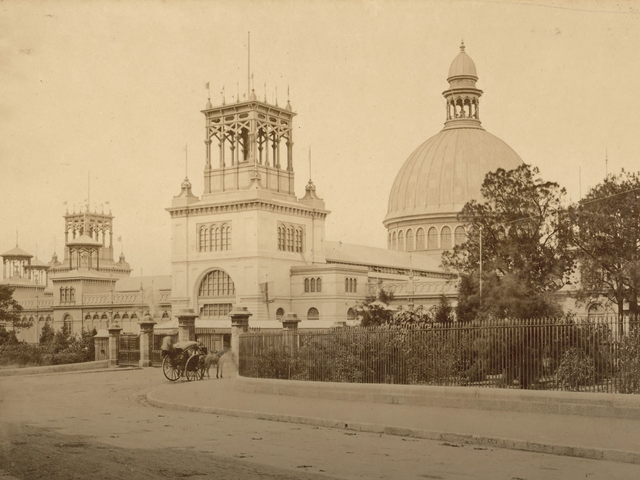
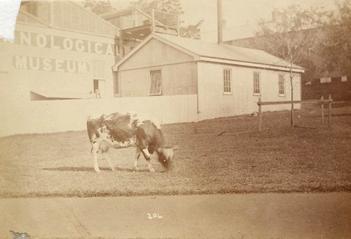
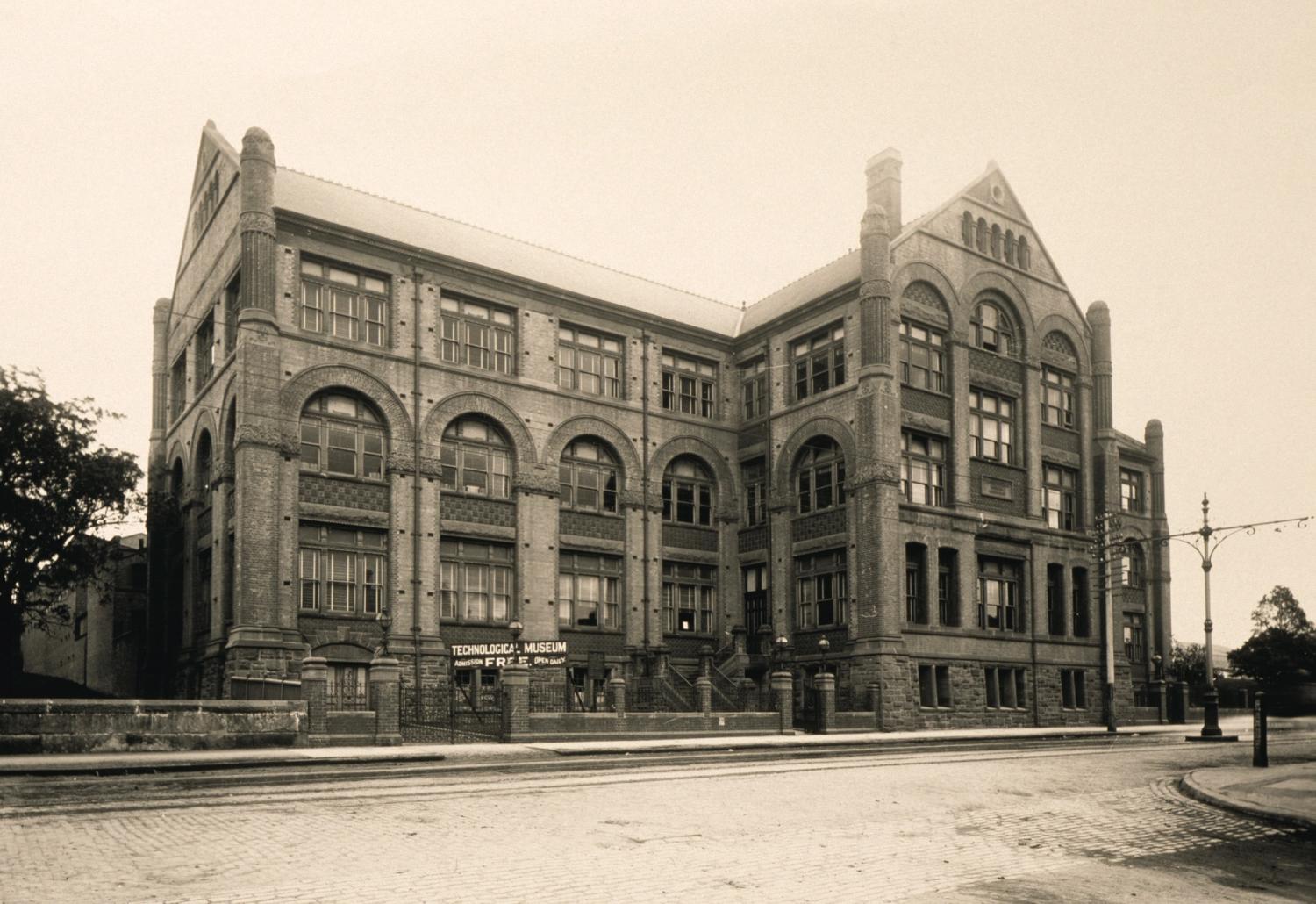
In 1910, Hargrave donated all but a few of his models to the Deutsches Museum at the instigation of Lieutenant Colonel Moedebeck of Germany. This action sparked considerable outrage, as space in the Technological Museum had been offered by the State Government to house the models. Although the newly opened Museum provided the models with a display area and an appropriate level of conservation care, they were not to escape the destruction of the Allied bombing of Munich during WWII. Fifty-seven models were destroyed out of a total of eighty. This prompted Stanley Brogden, who was responsible for inspecting the models at the time, to recommend that the Director of the Technological Museum in Sydney contact the Deutsches Museum advocating for their return. In 1960, this was made successful, and in the following year, nineteen objects were handed over to the MAAS. Four were temporarily withheld by the Deutsches Museum until copies were made and the originals returned to Sydney a short time later.

The second of four children of John Fletcher and Ann, Lawrence Hargrave was born at Greenwich, London on January 29, 1850. In 1856, Lawrence's father, eldest brother Ralph and uncle Edward emigrated to Australia in what appears to be a consensual marital separation between John and Ann. They were bound for Sydney to join a third brother of John and Edward, who was a member of the Legislative Assembly for New England (named Richard), while Ann, Lawrence and her two other children, Alice and Gilbert, stayed in Kent, England.

During his early years, Lawrence was educated at the Queen Elizabeth's School in Kirkby Lonsdale, Westmoreland, before he sailed to Australia in 1865 to join his father, brother and two uncles. John Fletcher, who was a distinguished judge in the New South Wales Supreme Court living at Rushcutters Bay House, anticipated a career for Lawrence in law. Despite organising tuition for him, Lawrence failed to matriculate, but was subsequently accepted to begin an apprenticeship with the Australasian Steam Navigation Company (ASN Co) in 1867. For five years he worked as an apprentice, gaining invaluable skills in woodworking, metalworking and design.

The circumnavigation voyage of Australia aboard the 'Ellesmere' (offered to Lawrence by another passenger en route to Australia from London) obviously stimulated an interest for Lawrence in exploration. From 1871, Lawrence joined the Committee of Management of J.D. Lang's New Guinea Prospecting Association and in 1872 was on board the brig 'Maria', bound for New Guinea in search of gold, when it sunk off Bramble reef, north Queensland, causing great loss of life. After returning to Sydney to work for the ASN Co, and later the engineers P.N. Russell & Co, Lawrence participated in several more exploratory voyages to the Torres Strait and New Guinea, accompanying figures like William Macleay, Octavius Stone and Luigi d'Albertis along the Fly River. These voyages continued until 1876, at which time Lawrence worked at the foundries of Chapman & Co, before choosing to settle down with new wife, Margaret Preston Johnson in September, 1878 with whom he had seven children (Nellie, Hilda, Margaret, Brenda, Olive, Geoffrey and Brenda-Olive).

In January of the following year, Lawrence commenced work as an extra observer (astronomical) at Sydney Observatory under the Government astronomer H.C. Russell. In this role, Lawrence was able to make a number of important observations and inventions, including the transit of Mercury in 1881, the Krakatoa explosion in 1883 and the design and construction of adding machines. The income made from land bestowed to Lawrence by his father in Coalcliff, however, meant that in 1883 Lawrence was able to resign from his position at the Observatory to pursue his fascination and study into artificial flight. This interest came about from his observation of waves and animal motion, including fish, birds and snakes.

Lawrence's earliest experiments, spanning 1884-1892, involved propulsion with monoplane models built from light wood and paper. He first attempted to build a full-size machine capable of carrying a human in 1887 and in 1889 he built his most influential engine - a three cylinder radial rotary engine. Lawrence's later experimental phase, 1892-1909, involved the use of curved surfaces in his models. This research subsequently led to the development of the box kite, the most famous invention associated with his name.

Lawrence always conducted his experiments in his local area (i.e. Rushcutters Bay, Woollahra Point and Stanwell Park). He was against patenting his inventions for fear of stifling the development of aviation in the bigger picture and therefore published his results quickly and widely, particularly through the Royal Society of New South Wales. This Society helped Lawrence to gain an international reputation and brought him into contact with other aviation pioneers like Octave Chanute and Otto Lilienthal. The very first paper he gave was "The Trochoided Plane" (delivered August 6, 1884).

In Lawrence's later years he conducted research into early Australian history, postulating the theory that two Spanish ships found their way into Sydney Harbour in the late 16th century. Apart from this and of course his interests in aeronautics, Lawrence also concerned himself with the contemporary issues of patent laws, free competition, Darwinism, a bridge for Sydney Harbour, pensions, strikes and conscription.

Lawrence Hargrave died of peritonitis at Lister Hospital on July 6, 1915. Lawrence's death came only nine weeks after the death of his youngest son, Geoffrey, at Gallipoli.

 This text content licensed under CC BY-NC.

Description
Medal and case, presented to Lawrence Hargrave's family by the Deutsches Museum, bronze, leatherette, velvet, wood, made by A Martio, Germany, 1925

A bronze medal, featuring a picture of the Deutsches Museum, in a navy blue case with gold embossed lettering on the front.

Made: Germany; 1925
Marks
See part records
H7393
Production date
1925

 This text content licensed under CC BY-SA.
Acquisition credit line
Gift of Helen Gray, 1963
This object belongs to:
Lawrence Hargrave Object Collection
Subjects
+ Hargrave, Lawrence
+ von Miller, Oskar
Short persistent URL
Concise link back to this object: http://from.ph/248314
Cite this object in Wikipedia
Copy and paste this wiki-markup:

{{cite web |url=http://from.ph/248314 |title=Medal from the Deutsches Museum |author=Powerhouse Museum |accessdate=21 May 2013 |publisher=Powerhouse Museum, Australia}}


Copyright
Images on this site are reproduced for the purposes of research and study only. Whilst every effort has been made to trace the Copyright holders, we would be grateful for any information concerning Copyright of the images and we will withdraw them immediately on Copyright holder's request.
Object viewed 6788 times. Parent IRN: 2142. Master IRN: 2142 Img: 17335 Flv: H:1012px W:1268px SMO:0 RIGHTS:.