Powerhouse Museum Collection Search 2.5
Category history:
   
Transport-Land > Motor cars

+ B1057 Automobile, full size, Detroit Ele...
+ B1090 Automobile, full size, Rover, 12 h...
+ B1134 Automobile chassis, full size, sec...
+ B1135 Automobile, full size, Internation...
+ B1339 Automobile, full size, Rolls-Royce...
+ B1503 Gearbox, sectioned, three speed ge...
+ B1507 Motor car, Australian Six, model N...
+ B1510 Automobile, 1908 De Dion Bouton, f...
+ B1515 1926 model Austin 7 hp Tourer. Alu...
+ B1568 Automobile, full size, Bentley, 3-...
+ B1662 Holden 48-215 (FX), automobile sed...
+ B1662-1 Holden Sedan Motor Car, 1948 mod...
+ B2339 Motor car, Qantas experimental ele...
+ B2420 Automobile, full size, Rolls-Royce...
+ B2459 Automobile, full-size, steam car, ...
+ B2475 Automobile, half-scale, Ford Model...
+ B2509 Automobile, 'EAW Special', racing ...
+ B2522 Automobile, Ford Prefect, converte...
+ B2533 Automobile, Sheffield Simplex, Typ...
+ B2603 Automobile and parts, full size, T...
+ 85/2202 Toy automobiles (27), Matchbox, ...
+ 85/2203 Toy automobiles & aircraft (23),...
+ 85/2204 Toy automobiles (30), Matchbox, ...
+ 85/2205 Toy automobiles & aircraft (36),...
+ 85/2206 Toy automobiles & aircraft (43),...
+ 85/2207 Toy automobiles (25), Matchbox, ...
+ 85/2208 Toy automobiles (12), Matchbox, ...
+ 85/2209 Toy automobiles (27), Matchbox, ...
+ 85/2210 Toy automobile, brochures and 'C...
+ 93/228/1 Toy cars (3) in box, FJ Holden ...
+ 93/228/2 Toy car in box, Torana GTR XU1,...
+ 93/228/3 Toy cars (2) in box, Ford Falco...
+ 85/2560 Toy cars & accessories (30), tin...
+ 85/2561 Toy cars (2), tinplate, France, ...
+ 85/2562 Toy cars & accessories (136), ti...
+ 85/2564 Toy cars & accessories (26), tin...
+ 85/2565 Toy cars & horsedrawn vehicles (...
+ 85/301 Automobile, electric power, Silen...
+ 85/485 Toy car, 'Oho', clockwork-operate...
+ 85/795 Automobile, FJ Holden (Special), ...
+ 86/1569 Toy Automobiles (24), "Matchbox"...
+ 86/1570 Toy Automobiles and Helicopter (...
+ 86/1571 Toy Automobiles (18), "Matchbox"...
+ 86/1572 Toy Automobile sets (6), "Matchb...
+ 86/1828 Automobile, design mockup, Holde...
+ 2002/7/1 Automobile, toy, Gate "VW Beetl...
+ 2004/50/1 Automobile, full size, EH Hold...
+ 87/1348 Automobile, cutaway display, sed...
+ 87/1608D Model car (cast), F J Holden, H...


Sectioned Ford Falcon XP car, 1964
Images: 01 02 03 04 05 06 07 08 09 10 11 12

The Falcon XP was the first Ford to challenge Holden's grip on the family car market. It epitomised the post-war attitude to cars in an era of prosperity; they were no longer cherished family heirlooms, but instead were consumer items. Although its engine was larger and styling sleeker when compared to earlier Australian-made Fords, its technology had changed little since the Second World War.

This 1965 'Fordomatic 3S' deluxe sedan was sectioned for display at a motor show in Melbourne, after which Ford donated it to the Museum. The sectioning shows not only the internal workings of the engine but also the construction of the body, upholstery, tyres, brakes and paintwork. It is one of a number of sectioned chassis and car bodies in the Museum's collection that were acquired when the Museum's exhibition role was primarily focused on technical education. At the time the Falcon proved to be of great interest to visitors, especially students from the School of Automotive Engineering at Sydney Technical College, who studied the exhibit as an example of the latest in automotive technology being made in Australia.

The Falcon XP was made between March 1965 and August 1966 and cost $2,140. Almost 71,000 were produced and by 1998 only 36 were still registered in New South Wales.


Margaret Simpson
Assistant Curator, Science & Industry
July 2008
The first Ford cars were sold in Australia in 1904 and a sales office opened in Melbourne in 1909, established by Ford of Canada. In the same year a local manufacturing plant was established in Victoria, at Geelong, 70 km SW of Melbourne. The Broadmeadows assembly plant was opened in 1958 and an engine machine shop built in the expanded plant two years later. This enabled production to almost double from 50,000 to 90,000 units in 1961.

The Ford Falcon range commenced in September 1960 with the XK and by 1962 the 100,000th Falcon had been built. The car and its successor, the XL, were based on a Canadian design with some minor modifications. With the following model, the XM in 1964, a more serious attempt at designing and making a car for Australian conditions was achieved, culminating in the XP with its Torque Box chassis which ran the entire length of the body, improved suspension and shock absorbers. In that year a durability trial organised by Bill Bourke, who was marketing the car for Ford Australia, saw five standard XP Falcons race around the clock for nine days around the rough and twisting 4 km dirt track of the You Yangs Proving Ground, Ford's new test track, between Melbourne and Geelong, aiming to cover 70,000 miles (112, 651 km) at an average of 70 mph (112.7 kph). Although several of the cars rolled over, they averaged 71.3 mph (114.7 kph) and undertook the distance in 8¾ days. Even Henry Ford II flew in and out by helicopter for the event. The publicity stunt established 49 Australian endurance records and established the Falcon's reputation as a tough family car. It was ordered by fleet managers, the police and for taxi fleets. The XP was named "Wheels" magazine's "Car of the Year" in 1965, the first Australian-made car to win this accolade, and the model turned the tide for Ford Australia as a serious competitor to Holden.

A total of 70,998 XP automobiles were made between February 1965 and September 1966. Thirteen models were made over that time: standard, deluxe, Futura and Fairmont sedans; standard, deluxe, Squire and Fairmont station wagons; deluxe and Futura 2-door hardtops; standard and deluxe utilities; and a van.

The XP's selling points for dealers at the time included a one-piece 8-inch (20.3 cm) deep chromed steel wrap-around bumper; engine insulation under the bonnet, a choice of three engines (the 96 hp "144" engine, the "Pursuit 170" and the "Super Pursuit 200"); a choice of manual, 2-speed "Fordomatic" automatic and 3-speed "Fordomatic 3S" automatic transmissions; a range of high-fashion colours including new metallic "diamond lustre"; massive chassis reinforcement members called "torque-boxes"; safety grooves in the wheel rims; self-adjusting brakes; chrome drip mouldings; classic large round Falcon tail lights; the spare wheel positioned upright in a well in the boot; vinyl seats and trim; interior insulation against heat and cold; ribbed floor mats, a zone of toughened glass in the front windscreen in front of the driver; 2-speed electric windscreen wipers; an illuminated selector quadrant on the steering column; and a dome lamp in the centre roof turret.

Accessories included an "auto-portable" transistor radio; fresh air heater and ventilating system; stainless-steel wheel covers and wheel discs; chromed locking fuel tank caps; deluxe rear vision mirrors; and windshield washers. Made in an era before car air-conditioning, the car could come with a range of accessories to combat the Australian heat, including exterior sun visors for the front windscreen; a Venetian blind for the rear window; and a weather shield for the driver's window.

"'65 Falcon Produce Review Booklet", (issued to Ford dealers), Product Training Dept, Ford of Australia, [1965].

Ford Falcon Registered Owner's Manual, [1965].

Wright, John. "The History of Ford Falcon 1969-1994", Ford Motor company Limited Australia, 1994.

"The XP Series Falcon 1965-66" in "Restored Cars", No. 162, Jan-Feb 2004, p.40.
The car was specially sectioned by a motoring display firm for Ford to exhibit at a Melbourne motor show. In October 1966 the car was donated to the Museum by the Ford Motor Company through Mr T.V. Myers of Vivian Expositions Ltd, Melbourne. The Museum was so pleased with the car that it was put on immediate display in place of the popular Cobb & Co. coach and the 1928 Chrysler chassis, which were put into storage. The Museum's "Annual Report" for 1966 noted that "the exhibit has proved very popular, but to further increase its interest preliminary tests have been carried out to install a push button tape-recorded description of the working car".

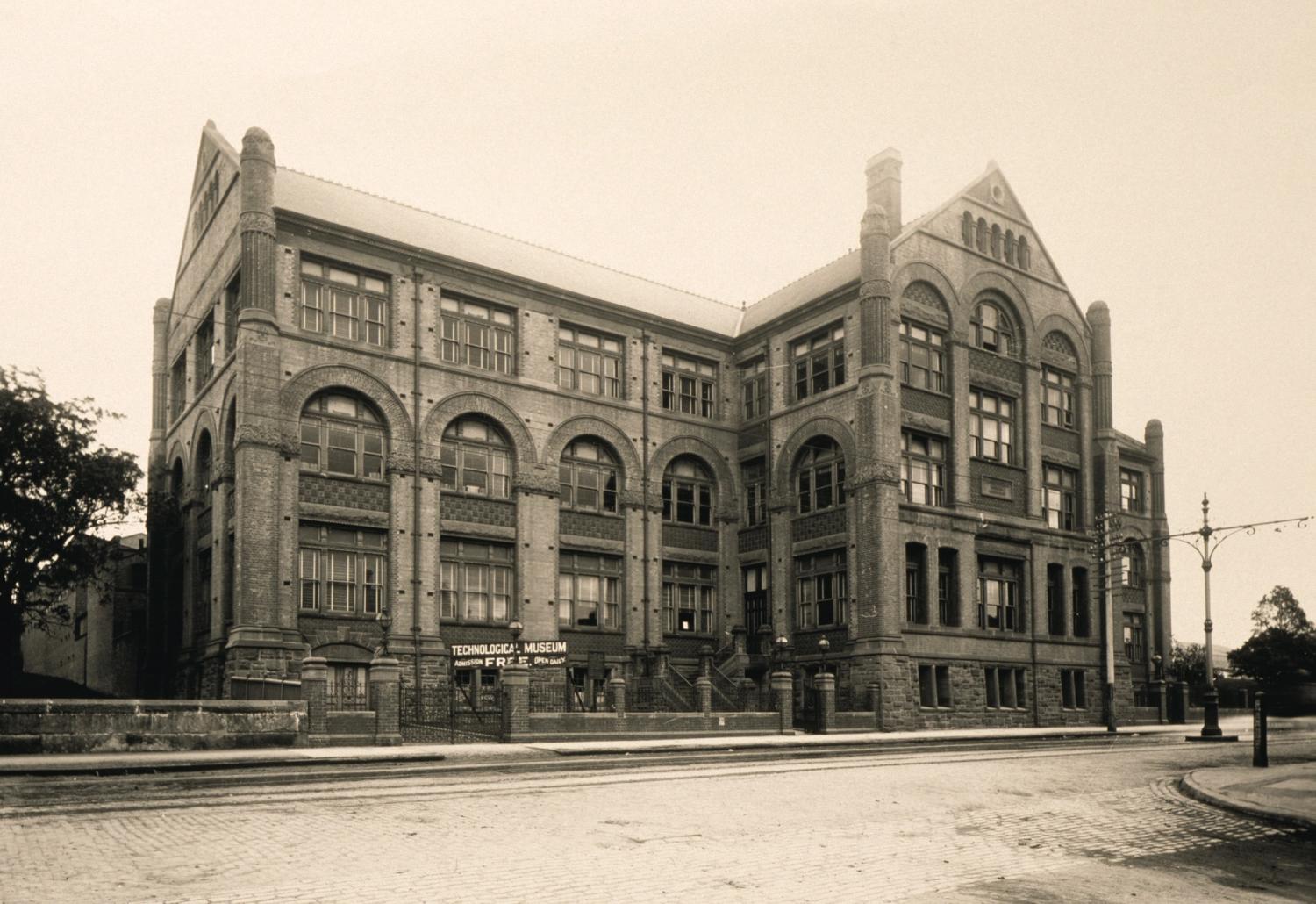
For some years the sectioned Ford was on display in the Museum's old building in Harris Street, Ultimo. It then went into storage and was brought out again to display in the "Transport" exhibition of the Powerhouse Museum, which opened in 1988. The car returned to Victoria on loan in 1999 and was displayed at the Ford Discovery Centre at Geelong until 2005, when it was taken back to the Museum's store at Castle Hill.

 This text content licensed under CC BY-NC.

Description
Sectioned automobile, Ford Falcon XP, Deluxe Fordomatic 3S, 5-passenger, 4-door sedan, made by Ford Motor Company of Australia, Broadmeadows, Geelong, Victoria, 1965

The car is completely sectioned to show details of the internal construction and workings of the vehicle. The car is fitted with a straight 6-cylinder "Pursuit" engine, with the inlet manifold cast integral with the cylinder head. It has hydraulically-operated overhead valves, three-speed "Fordomatic 3S" automatic transmission, self-adjusting brakes, and a dished safety steering wheel.

Several parts of the body have been removed, including the offside half of the roof, the offside doors, the offside front mudguard (to show the front suspension), as well as the bonnet, to show the internal workings of the car. Inside, the upholstery of the driver's seat has been sectioned to show the cushion construction, and the steering wheel and dashboard are sectioned. Part of the bumper bar and radiator grille have been cut out, and the engine and battery have been sectioned. The boot lid is divided into strips to show the various stages of the painting process from bare metal through priming coats and black dip to the final enamel coats. A concealed electric motor can set the engine and transmission in motion, and a specially designed lighting system illuminates the interior.

Specifications
Model: XP Falcon deluxe sedan Fordomatic 3S
Gearbox: 3 speed automatic (Borg-Warner)
Engine: "Pursuit 170" water cooled, overhead valve
Cylinders: 6 in line
Bore & stroke: 3.68 in x 3.126 in (89 mm x 75 mm)
Capacity: 170 cu in. (2786 cc)
Compression ratio: 8.7:1
Maximum torque: 156 lb/ft (211 Nm) at 2400 rpm
Maximum power: 121 bhp (90 kW) at 4400 rpm
Top speed: about 95 mph (153 km/h)
Brakes: 9 inch (22.9 cm) drums front and rear
Fuel system: single throat carburettor
Fuel tank: 11.7 gals (53.2 litres)
Steering: recirculating ball, ratio 27:1
Wheelbase: 9 ft 1½ inch (2781 mm)
Wheels and tyres: pressed steel disc wheels with safety rims
Rear axle ratio: 3.50:1
Performance: 0-60 mph (0-96.6 kph) in 14.5 seconds
Total production: 70,998

-1 Car
-2 Tub of part
-3 Keys
-4 Horn ring
-5 Number plate
-6 Drive chain
-X Cover and transport wheels (2)

Maker: Ford Motor Company; Geelong, Victoria; 1964
Marks
See part records for details
B1644
Production date
1964

 This text content licensed under CC BY-SA.
Subjects:
+ Land transport
+ Motoring
+ Driving
+ Mass production
+ Motor vehicle industry


Copyright
Images on this site are reproduced for the purposes of research and study only. Whilst every effort has been made to trace the Copyright holders, we would be grateful for any information concerning Copyright of the images and we will withdraw them immediately on Copyright holder's request.
Object viewed 5183 times. Parent IRN: 410. Master IRN: 410 Img: 116632 Flv: .