Object statement
Windows, 'Art Deco', metal / glass, made by [Wunderlich Ltd], Redfern, Sydney, New South Wales, Australia, 1928-1929
This object was removed from the Wunderlich Showroom, in Redfern. The Showroom was constructed in 1929 and was one of the first substantial Art Deco interiors produced in Australia.
The idea for the Showroom came from Ernest Wunderlich, who four years previously had visited the 1925 Paris exhibition, the first international exhibition devoted to 'modern' design and decorative arts. The exposition Internationale des arts Decoratifs et industriels modernes featured pavilions from most European countries but was dominated by French designers working in the fusion of industrial manufacture and decorative modernism later known as Art Deco. [1]
In his travel dairy, Ernest Wunderlich described the Paris exhibition as 'pleasing and striking�Even when the designs are outré, they always are artistic and possess a cachet of their own�although some of the pavilions are most brazen innovations on what we would consider artistic fitness, they are strikingly original and attractive�' [2] By 1928 Wunderlich's staff designers George Paterson and Ralph Ferris had introduced the simple geometrical forms of Art Deco to Wunderlich's stamped metal designs.
Paterson and Ferris also worked on the design of a new showroom at the Redfern factory. As well as providing display space for Wunderlich products, the impressive hall would also serve one of the Company's aims of preserving a level of personal contact with employees, thus maintaining solidarity between employees and management. [3] Construction of the Hall was completed in 1929 and although within three years the Hall had lost its social function, it continued as a showroom.
Although the majority of the room was in the Art Deco style, many of Wunderlich's products from different stylistic periods were displayed. One of the main features of the Showroom was eight columns and pilasters in glazed terracotta, surmounted by sinuous Art Deco capitals in hammered bronze. The stamped metal ceiling was also a highlight, demonstrating fifteen different types of ceiling covering the following periods: Classic, Gothic, Tudor, Louis, Elizabethan, Jacobean, Georgian, Adams, Art Nouveau, and Art Deco. Clerestory windows in Wunderglaze (a lightweight version of stained glass) surrounded the room, featuring a sun burst pattern, perhaps the most popular Art Deco motif. [4]
In 1969 the Wunderlich Company was taken over by Colonial Sugar Refining Company Limited (CSR) and de-listed on the Australian Stock Exchange in 1970. By that time acoustic ceilings and wall cladding had been installed in the Showroom, obscuring most of its original features. The 1929 Wunderglaze and bronze lights had been lost.
This object was acquired by the Museum in 1980, when CSR demolished the Redfern Factory after it had fallen into disuse for many years. The Museums Director at the time recognised the "significance of Wunderlich Ltd as a paradigm of a development which combined features of industrial, social, technological, and artistic endeavor". [3]
Wunderlich products found their way into many aspects of Australian life from grand facades like the Government Bank in Martin Place, to domestic ceilings, to garbage bins, and engine cowlings produced as part of the war effort. Wunderlichs ceilings, walls and structural panels were found all over Sydney City and were one of the major decorative and stylistic influences on the architecture of buildings for well over 40 yrs.
The Museum's Wunderlich Collection is a valuable and pioneering study in Australian social and industrial history, which links documentary material and actual products and processes. The objects from the Showroom are significant in the part they played in creating one of the first substantial Art Deco interiors in Australia.
Reference:
[1] Forty Years of Wunderlich Industry 1887-1927, Wunderlich Ltd, 1927
[2] Earnest Wunderlich, All my yesterdays: A mosaic of music and manufacturing, Angus & Robertson, Sydney, 1945, pp.93-94.
[3] The Wunderlich New Social Hall and Showroom, A brochure commemorating the official opening, 18th December, 1929.
[4]Susan Bures and Barry Groom, Wunderlich Project Report, Museum of Applied Arts and Sciences, 1980-1981
Charles Pickett- Curator
Erika Dicker- Assistant Curator
October, 2008.
This window was manufactured for use in the 1929 Wunderlich Showroom, at their Redfern factory.
The entire decorative scheme of the Showroom was carried out with Wunderlich products, all manufactured in Australia. The company claimed that the only materials not from their own manufacturing plants being the parquet flooring and the window glass, the former an Australian product supplied by G. Hudson Ltd.[1]
The architect for the building was Sylvanus Gladstone Evans, the Wunderlich company architect at the time. The interior designers were most probably company draughtsmen George Patterson and Ralph Ferris. [2]
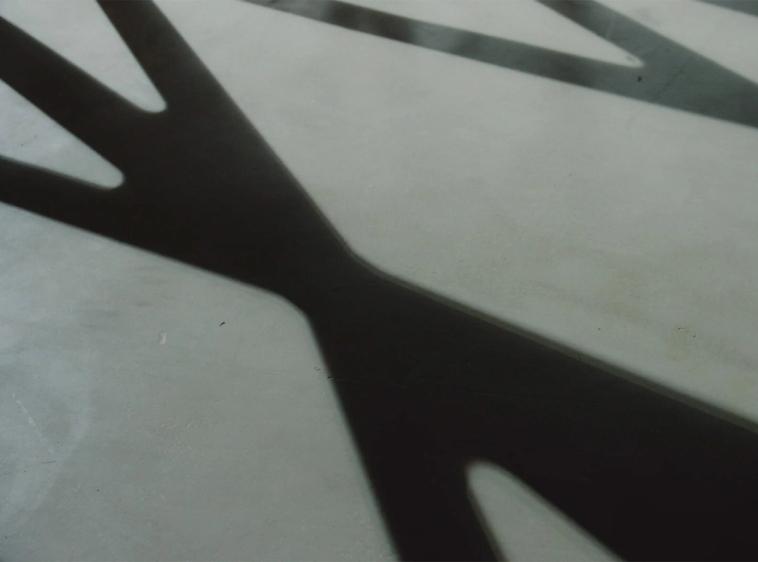
One of the highlights of the Showroom was the ten large Art Deco windows, each decorated with a 'sunburst' pattern. Originally each large Art Deco window was set into a metal frame attached to an outer frame by a pivot, which allowed the windows to swing open. The inside frames ran around the majority of the room and were unable to be salvaged by the Museum. The frames that are in the Museums collection were kept as an example of how the window opening mechanism worked. [3]
Reference:
[1] The Wunderlich New Social Hall and Showroom, A brochure commemorating the official opening, 18th December, 1929.
[2] Oral histories with Wunderlich employees A. J. Bailey and J. Mogg, Powerhouse Archives
[3] Susan Bures and Barry Groom, Wunderlich Project Report, Museum of Applied Arts and Sciences, 1980-1981
This object is part of the Museum's 'Wunderlich' collection, which was acquired by the Museum in 1980.
Wunderlich Limited was one of Australia's most significant building companies during the late 19th and early 20th centuries, and created elements of many significant Sydney buildings, including the Centennial Hall ceiling in the Sydney Town Hall.
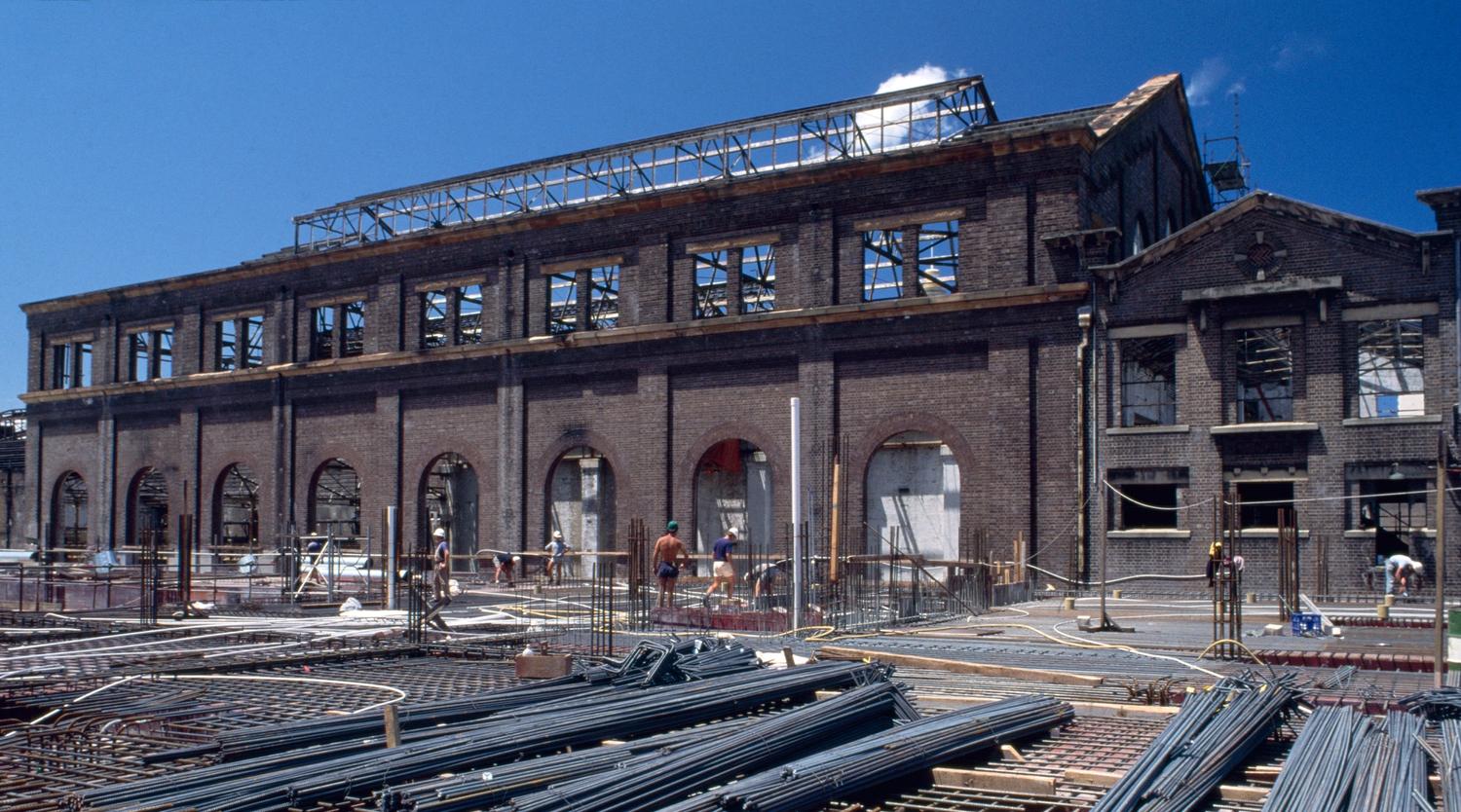
In 1969 the Wunderlich Company was taken over by Colonial Sugar Refining Company Limited (CSR) and de-listed on the Australian Stock Exchange in 1970. In 1979 CSR sold Wunderlich's Redfern site, with all the original buildings to be demolished to make way for a shopping centre. In November, that same year, CSR gave the Museum $20,000 to rescue the collection of the Wunderlich Factory, before it was lost forever.[1]
This artefact came from the spectacular Art Deco showroom created by the company in 1929. The rectangular showroom had a clerestory supported by eight massive pillars in glazed architectural terracotta and capped with hammered bronze capitals. The ceilings and cornices were decorated with stamped metal and the wall panels around the room illustrated 15 historical styles from Classical to Art Deco. This showroom had then been renovated by Wunderlich some time in the 1950s.
The Museum employed the assistance of Industrial Archaeologists to help preserve and document the site before its demolition. The Curator in 1980, John Wade, thought it imperative to act quickly as demolition had already begun by the time Museum staff could get to the buildings, and numerous objects were being stolen from the demolition site on a nightly basis. The archaeologists were racing the bulldozers to preserve what was left of the site and worked quickly to preserve anything they could.[2]
Even amidst the chaos of demolition the Museum staff described the hidden wonders of the site: "Under the walls and ceilings of the 1950s showroom, team members found a treasury of art deco, including tiled columns capped with copper, pressed metal ceilings above low slung acoustic ceilings and, outside the showroom almost hidden by a display of roofing tiles were walls ornamented with terracotta medallions and elegant brick work"[3]. Examples of all these architectural components were saved by the team, along with numerous catalogues and architectural plans, which were turned into an archive.
This collection is again being worked on in 2008, as part of the Total Asset Management Collections Project, to increase accessibility of documentation relating to the Wunderlich objects. This collection project has not only preserved some of its products, but has given an insight into the development, operation and impact of a great Australian company, which became an institution.
Reference:
[1]Susan Bures and Barry Groom, Wunderlich Project Report, Museum of Applied Arts and Sciences, 1980-1981
[2]Memo from John Wade to acting director D. Walsh, Museum Archives
[3]"Wunderlich story to be persevered", Sydney Morning Herald, 6th March 1980
John Wade, 'Rediscovering Wunderlich', Heritage Conservation News