


Object statement
Architectural model, National Athletics Stadium (Canberra Stadium), Australian Capital Territory, cardboard / plastic, Philip Cox / Cox Architects, Australia, 1974-1977.
The National Athletics Stadium is an important building in the history of Australian architecture, being one of the first sporting stadiums designed as an integrated facility of playing field, seating and other surrounding structures. Although large stadia existed in Australian long before 1977, these were primarily constructed piecemeal as grandstands and other structures were added and altered subsequent to the creation of a playing field.
In addition, the National Athletics Stadium featured supporting masts and cables to suspend a roof above spectator seating. The immediate purpose of this design was to create an unobstructed view and to maximise the space available to seating. However the independence of suspended roofs from the seating structure gives them exceptional aesthetic and functional potential. In Canberra the roof was counterposed to a landscaped stadium bowl. The suspended roof form was further exploited in Philip Cox's subsequent design for the Sydney Football Stadium completed in 1988. The undulating circular roof of this venue was well publicised internationally and can claim to be the forerunner of several similarly spectacular stadium structures built since.
In this respect the Canberra Stadium and the SFS can be viewed as part of the second generation of stadium design since architects began designing complete stadiums during the 1930s. The first generation was the numerous concrete bowl stadiums designed in the wake of Rotterdam's Der Kuyp stadium and Berlin's Olympic Stadium, both completed in 1936. One of these - Rio de Janiero's Maracana - remains the largest stadium in the world. Steel structuralist designs first appeared during the 1950s, notably the Melbourne Olympic Aquatic Centre designed by John and Phyllis Murphy, Peter McIntyre and Kevin Borland. Cox developed this design language in new ways, although his Canberra Stadium design also owes a clear debt the 1972 Munich Olympic Stadium designed by Gunther Behninsch and Frei Otto.
The current generation of stadia is partially typified by Cox's ground breaking National Tennis Centre, with its retractable roof enclosing the centre court arena. In addition Cox has developed stadium roof design in one of his most recent designs, the Melbourne stadium (AAMI Park). This much-awarded design is notable for a lightweight steel design integrating the roof, wall and connection elements into a single structure.
Charles Pickett, curator Design and built environment
Philip Cox (b.1939) is one of Australia's most prolific and influential architects. Shortly after graduating from the University of Sydney in 1962 Cox went into partnership with established architect Ian McKay. This alliance facilitated work on two large projects early in Cox's career. The first was a boys's home for the Presbyterian Church at Emerald Hill, Leppington, the second the Alexander Agricultural College at Tocal, near Paterson in the NSW Hunter Valley. These projects were awarded the Sulman Prize in 1963 and 1965 respectively.
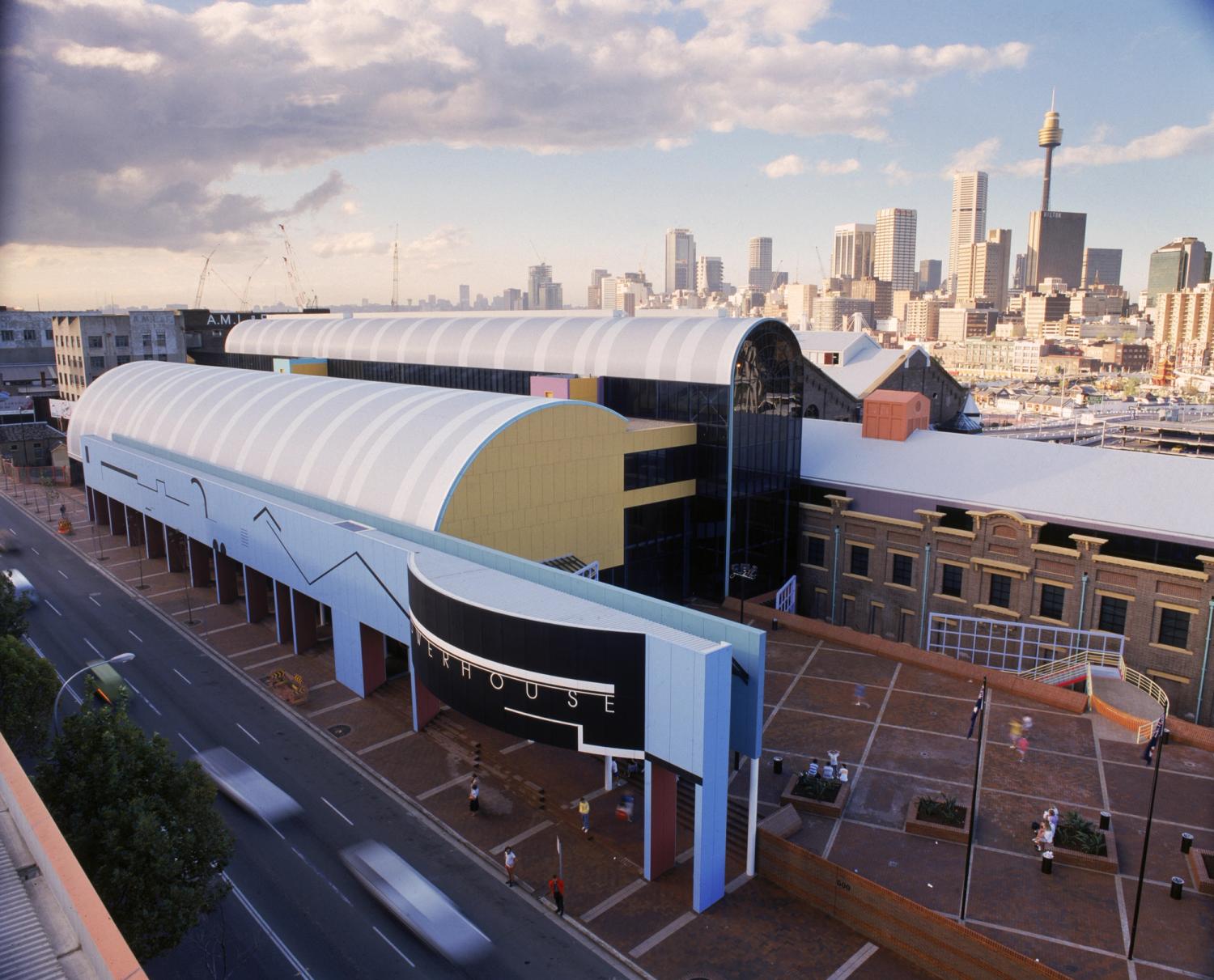
Cox formed his own practice in 1972. The National Athletics Stadium and adjacent AIS Sports and Training Centre were its first major projects. They were doubly significant is establishing the steel structuralist design vocabulary associated with Cox from this time and used in numerous high-profile projects including the Sydney Exhibition Centre, Darling Harbour, the Australian National Maritime Museum and the Uluru Tourist Resort.
The Canberra venues also laid the foundations for Cox's eminence in the new (in Australia) field of stadium architecture. In this field Cox's work includes the Sydney Football Stadium, the National Tennis Centre, Melbourne, the Sydney Showground Arena, AAMI Park, Melbourne and the Khalifa Stadium, Doha.
Cox and his practise have been influential in several building genres. During the 1980s Cox Architects designed some significant low-rise public housing apartment complexes in Wolloomooloo and other Sydney locations. These projects created new neighbourhoods carefully integrated with established but socially and architecturally challenged areas. The urban renewal theme is also evident in Cox's design for the Haymarket campus and library for the University of Technology, Sydney.
Other Cox buildings sited close the Powerhouse Museum are the UTS Design, Architecture and Building Faculty on Harris Street and the neighbouring second (TV studio) stage of the ABC complex.
The National Athletics Stadium was completed in 1977 as the track and field venue for the newly-established Australian Institute of Sport. It was also the venue for the Pacific Conference Games hosted the same year and in 1985 was the venue for the IAAF World Cup, a track and field tournament now known as the IAAF Continental Cup. Seating capacity was increased from 8,000 to 12,000 for this event.
In 1990 the running track was removed and the stadium was used regularly for rugby league, rugby union and football matches. During the late 1990s the stadium was extensively renovated to host football matches during the 2000 Olympic Games. The field area was reduced and reconfigured to a rectangular shape while extra seating, roofing and facilities were installed. The final cost of these changes considerably exceeded the ACT Government's estimate; this controversy was a major element in the demise of Kate Carnell as ACT Chief Minister. For most of this time the venue was known as Bruce Stadium after its suburban location.
In its current form Canberra Stadium has a seated capacity of 25,000 although despite the addition of a second roof stucture much of the seating is not under cover.