Guest Curator – Maduncle Cliff, Steampunk part 1

Cliff Overton © all rights reserved.

The Museum was recently visited by artist, tinkerer, and ‘Steampunk’, Cliff Overton, who runs the ‘Antipodean Steampunk Adventures’ blog, and is currently exhibiting some of his works at the Museum of the History of Science in Oxford as part of their ‘Steampunk’ exhibition. We caught up with him to find out more:

Hi Cliff, would you tell us a little about this ‘Steampunk’ business, what it means to you, and how you got interested in it?

Well – Steampunk found me really, in that a dear friend of mine showed me a website with a picture of a computer keyboard made from old typewriter keys (google Datamancer for more). I looked at that and thought, ‘that looks like the sort of things I build for the fun of it’ so I guess I was doing Steampunk stuff before I knew about Steampunk. I have always collected parts of old things and then tried to put them together in new ways.

A lot of this was my rebellion against my chosen proffession at the time – that of an Industrial Designer. Everything I did professionally had to look new and sleek and hi tech – wheras my art using found objects was very ‘function followed form’ based and more ad-hoc in design outcome.

Cliff Overton © all rights reserved.

One of my first builds – circa 1997 (I still have it).

So I did more research on Steampunk via the web, got on some forums, made some friends, met up with a few local devotees at a flea market in Camberwell and things have snowballed from there.

I needed a moniker – so I returned to my past as an industrial designer and re-adpoted the name ‘maduncle’ given to me by a shop owner who was selling some of my furniture many years ago.

I think a big part of the steampunk subculture is around having a steampunk persona you can develop. I am modelling myself on the Victorian scientist/inventor philanthropist type. Although I am yet to get myself a genuine vintage collapsable silk topper that fits. (big hint here – got any spares in storage?)

Although I do have an Etsy site and I do sell some of my work, I am not in it as a business. It is more of a ’show and tell’ exercise, and then I pass on the finished item at a reasonable cost to an admirer. The greatest compliment is getting commissioned work, that shows the growing interest in the Steampunk style as a medium for other products.

Cliff Overton © all rights reserved.

My first commission – the ‘Damnation PS3′ for the launch of the computer game of the same name. 2008.

I would like to see a ‘proper’ exhibition of Steampunk art here in Australia – a lot of the work in Europe and the USA is stunning.

Right now I am making a new series of objects called ‘Specific Devices’ inspired by my visit to the Powerhouse Museum. Some of them will look old and purposeful, without anyone (including me) knowing their real purpose. Others will have a real use (such as the examinerscope I built recently).

Q. So what did you find in the Museum’s collection that inspired you?

babbage difference engine

Collection; Powerhouse Museum

The absolute ‘oh how I wish I could sneak you out past the guards and take you home’ stand out item was the Babbage difference engine component on display.
Photography by Powerhouse Museum © all rights reserved

That was a very ’steampunk moment’ for me. I would love to build a complete one – I have seen a working Meccano one so it can’t be that difficult…

Cliff Overton © all rights reserved.

Other than that, all of the old scientific devices on display (well – all the brass ones) and of course the steampowered section. The old brass devices did inspire me to make my first ’specific device’.

What is particularly intertesting for my wife Tanya and I is that we did not know there was a real Strasbourg clock, let alone a replica in the Powerhouse, and we will be in Strasbourg in September. So we are already planning a special visit to the life size clock, now we have seen the model.

To Be Continued……..

Old battery reveals its secrets

Collection, Powerhouse Museum

Have you ever chopped up a battery to see what’s inside? I certainly did as a child (but please note this can be a dangerous activity). Years later I was delighted to find this carefully sectioned 1920s Columbia Ignitor on a shelf in the Powerhouse basement.

Collection, Powerhouse Museum

I thoroughly enjoyed researching this wonderful didactic object. It’s not everyone’s cup of tea, but I find its multiple shapes, layers, colours and textures visually pleasing. And it took me on an interesting journey into the worlds of chemistry, materials, invention (by Leclanché), commercialisation (by Gassner), brand names, iconography, technological history and the social impacts of technology.

We all know that technology transformed daily life in the twentieth century, and that batteries were crucial for the move to portable devices. Batteries themselves have been progressively reduced in size. At 160 mm tall, this one would be useless for powering an iPod or Xbox, but it was well suited as an ignition source for two transformative technologies: the motor car and the landline telephone.

Collection, Powerhouse Museum.

These initial applications explain the name Ignitor, but what are the origins of Columbia and the National Carbon Company? I was surprised to learn that Columbia is a feminised version of Columbus – today this seems a strange way to commemorate such a man, but the name was coined in a more poetic, less prosaic, age.

On the other hand, I wasn’t surprised to discover that the National Carbon Company (later to become part of Eveready, which morphed into Energizer) started out as a supplier of carbon rods for arc lamps, the first form of electric lighting.

Note the fluted form of the carbon rod at the centre of the battery. Fluted carbon rods were first used to maintain constant timing of the light pulses produced by lighthouse arc lamps despite changes in current and voltage (which had to be increased to produce brighter light in poor weather). As this timing ’signature’ is used by mariners to identify individual lighthouses, the introduction of the fluted rod was an important safety measure. In the battery, fluting serves to increase the surface area of the electron-collecting rod – that is, in comparison to a plain cylindrical rod such as the one in the battery I investigated as a youngster.

Samoan War Photographs 1899

U.S. Marines with naval gun, Upolu, Samoa, 1899, published by Kerry and Co.

U.S. Marines with naval gun, Upolu, Samoa, 1899, published by Kerry and Co.

Here, then, is a singular state of affairs: all the money, luxury, and business of the kingdom centred in one place; that place excepted from the native government and administered by whites for whites; and the whites themselves holding it not in common but in hostile camps, so that it lies between them like a bone between two dogs, each growling, each clutching his own end. Robert Louis Stevenson 1892

The above quote taken from Stevenson’s insightful, and surprisingly humorous, account of the war which erupted at Apia in Samoa is proof even great writing can fail to turn the tide of war. In this 1889 encounter peace was only reached after nature herself intervened in the form of a hurricane. Playing no favourites it sank and damaged all but one of the American, German and British ships confronting each other in Apia harbour.

Unfortunately Stevenson’s object lesson in the pointlessness of war appears to have been ignored. As a result the people of Samoa were faced with the exact same predicament as European intrigue exacerbated existing tensions in Samoa which erupted into civil war in 1899. In an astounding turn of events the American heavy cruiser U.S.S. Philadelphia shelled Apia on March the 14th almost ten years to the day of the anniversary of the hurricane which ended the first conflict.

The shelling was done in an attempt to dissolve a provisional government set up by Mata’afa and Germany but instead it inflamed the hostilities and Mata’afa’s forces attacked houses in Apia, particularly the Tivoli Hotel where three American sailors were killed. On 30 March a British and American force under Commander Sturdee, along with about one hundred Samoans supporting chief Malietoa under Lieutenant Gaunt, made their way along the coast driving small numbers of Mata’afa’s men before them.

Malietoa supporters and United Sates marines on the streets of Apia, 1899, published by Kerry and Co.

Malietoa supporters and marines on the streets of Apia, 1899, published by Kerry and Co.

On the first of April, and no doubt feeling full of confidence at the ease with which they were forcing Mata’afa’s forces off the coast, they pursued him inland. This tactic was foolhardy in the extreme as they were no longer covered by the fire of the warships and were attacked by thousands of Mata’afa’s men. While only seven were killed, the historian Paul Kennedy considered these were, ‘remarkably light considering the circumstances’. The upshot of all this activity was the establishment of Samoan, American and British forces along the coast while Mata’afa’s Samoan forces and the Germans were firmly entrenched in the interior. The inevitable deadlock was broken by a ceasefire announced on 25 April and in May 1899.

This second conflict was not covered by the Stevenson’s pen but by another medium, photography. The Powerhouse Museum’s ‘Tyrrell Collection’ contains twenty-six glass plate negatives taken during the conflict, which, while not containing the erudite flourishes of an author, do give us some realistic insights into this civil war. These photographs were originally published by the Sydney firm of Kerry and Co., although it is unlikely the company actually took the photographs themselves.

The 80s are Back- logistics of display

Photography by Emma Bjorndahl © Powerhouse Museum, all rights reserved.

It appears that the curatorial team are trying to break the PHM world record of number of lenders per exhibition. Currently sitting on about 70 lenders I understand they will settle for no less than …..yes, you guessed it 80 lenders – it’s a numbers thing.

Supporting the curators are a dedicated bunch of staff members virtually throwing LP covers and stuffed toys at the exhibition, revealing an awful lot about themselves in the process, or at least what they were up to in the 80s. To date fifteen staff members have kindly lent their beloved belongings including 94 LP covers, a plethora of posters, princess Diana doll (really Kathleen!) a care bear, Garfield, glo worm and of course a piece of the Berlin wall and motor scooter.

So what do they have to beat – a quick check of other exhibitions has me noticing a bit of a curatorial link here.

The top three loan generating exhibitions over the last 15 years are: 69 lenders for “Spinning around”, 83 lenders for “On the box” and a whopping 110 for “Real Wild Child” (including the travelling component). All of these exhibitions were the work of curator Peter Cox!

But this exhibition is more than the sum of its loans, the exhibition draws from the museums own collection and collected archives. The number of objects (not including parts) in our collection database which have been selected for the 80s exhibition is sitting at around 570 which includes furniture, textiles, numismatics, radios, badges, posters and much, much more.

Basically if it existed in the 80s we have one (or two) on display!

Come and visit the exhibition!

Underwear for down there

Photography by David Mist © all rights reserved. 96/44/1-6/3/1. Above - negative of female model's torso, 1969. Collection, Powerhouse Museum.

Venus Williams turned heads this week with her skin coloured underwear (see the controversial shot here), leading many to believe she actually forgot to put her underpants on! Venus designed the underpants for her fashion label ‘EleVen’, saying they were meant to “highlight the thigh-high and V neck splits” of her dress.

Skin-coloured underwear has been around for a long time. Until the beginning of the 20th century, underwear was usually white because washing was done with bleach and boiled water. As clothing became less voluminous and finer and more translucent fabrics (such as silk) were used, skin-coloured and white underwear was worn to maintain modesty.

The Powerhouse Museum has a diverse range of underwear that could easily rival Venus in the fashion stakes (even if they are completely impractical for tennis) and which are bound to capture the imagination of our readers!

Designed by Berlei. Collection, Powerhouse Museum.

A8211-8.

Our first example is a matching bra and brief set of cream coloured stretch nylon with a silky satin finish, decorated with white fabric and yellow velour centred daisy flowers. It was designed and made by Berlei Ltd in Australia in 1970 as a reference sample. The Powerhouse Museum holds the Berlei Ltd archive in its collection.

Designed by Issey Miyake. Collection, Powerhouse Museum.

 2001/106/2.

This is a pair of hipster underpants, belonging to an ensemble (known as ‘A-POC’- an acronym for ‘A Piece of Cloth’) which includes a top, skirt, bra, socks, gloves, hat and a bag designed by Issey Miyake in Tokyo, Japan in 1999. They are made from a stretch double knit fabric of cotton, nylon and polyurethane, unsewn and unlined, with a diamond and stripe design and short fringe around the leg holes. The pants, like all the pieces in ‘A-POC’, were produced using computer software linked to a basic knitting machine normally used for making hosiery.

Designed by Baz Luhrmann, Catherine Martin and Angus Strathie. Collection, Powerhouse Museum.

2008/199/7.

This is a pair of yellow cotton French knickers worn by Veronica Beattie for the Tattoo Can Can in the movie, Moulin Rouge. It was designed by Baz Luhrmann, Catherine Martin and Angus Strathie in Sydney, 2000 and features clear sequins and beads down the centre front seam and under the crotch; black embroidery and appliqué decoration around the gathered legs and the waist is fastened using a drawstring. This is one of six elaborate pairs of knickers designed and made for Moulin Rouge in the Museum’s collection.

Designed by Bonds. Collection, Powerhouse Museum.

2008/40/1.

In October 2002, Bonds released a winter collection of women’s cotton underwear inspired by the bold prints and colours of 1960s graphic design, among which included this particular set. The hipster, boyleg-cut underpants, made of printed cotton elastine jersey, were designed by Georgina Braham in Wentworthville and made by Bonds Industries Ltd in China. This range formed part of the company’s move away from their traditionally plain colours and styles to a revitalized range of printed and coloured underwear, which catered for a younger, female market.

Designed by Gretel Pinniger. Collection, Powerhouse Museum.

 A8203.

This is a leather and animal fur g-string designed by Gretel Pinniger, aka Madame Lash, in 1981. It was actually made especially for display in the exhibition ‘The Fabric of History’ held at the exhibition centre, ANZ bank in Martin Place in July, 1981, along with other examples of leather costume and accessories, later acquired by the Powerhouse.

Collection, Powerhouse Museum.

 H5343.

This is an example of men’s underwear from the 1950s made of Terylene (polyester), before the introduction of printed and coloured garments which emerged in the same decade.

Collection, Powerhouse Museum.

H6699-6.

These open-leg bloomers were practical examples of underwear for women in the 19th century. They allowed women to squat and go to the toilet without having to remove layers of clothing, which was much easier than undoing tapes and waistbands which kept petticoats in place.

Collection, Powerhouse Museum.

95/163/1.

And, this is a pair of women’s cotton underpants from China dated to 1994. They are army green in colour and feature a sneaky little zippered pocket in the front with the words ‘High class anti-bandit underpants’! This suggests the pocket was used for hiding much sought after personal belongings, perhaps money or car and house keys, although it may have also been used for holding condoms – to serve as a subliminal message of safe sex and to try and curb the escalating Chinese population.

In light of these examples from the Museum’s collection, I don’t think Venus’s choice of underpants were that shocking after all! What do you think?

Back to School lunches

Collection, Powerhouse Museum.

This poster from our collection was issued by the NSW Department of Health in the 1950s. It shows the wise headmaster (in cap and gown) pointing out the formula for a healthy lunch to Jimmy who stands to attention with his hands behind his back. I’m not sure what to make of Jimmy’s expression – surprise or perhaps alarm at the prospect of wholemeal bread and butter with meat and salad or fruit?

The same health message is still promoted today, however, these days taste and variety are just as important in appealing to healthy eating habits. Look at this example about bread from the Children, Youth and Women’s Health Service of South Australia.

Courtesy of Children, Youth and Women’s Health Service of South Australia

The site lists 14 varieties of bread (not counting the “heaps of others”) and is aimed at children shopping for what they like themselves.

I doubt Jimmy (or even the headmaster) would have known more than two varieties of bread – Wholemeal (or Brown) and White.

When I was in school Vegemite sandwiches on white bread were the staple for many of us. What did you have in your sandwiches?

Esmarch Triangular Bandage

bandage 002

Collection, Powerhouse Museum.

When I came across the Esmarch triangular bandage in my research, I was immediately drawn to the line (After Esmarch).

bandage 003

Collection, Powerhouse Museum.

Was it a person, place or manufacturer? And why was the bandage after Esmarch? To my delight, I discovered Esmarch was a person.

Today, a bandage seems like a normal thing for one to encounter in a first aid kit. This was not always the case. The triangular bandage is attributed to Johann Friedrich August von Esmarch. Esmarch was born 1823, a German surgeon who specialized in trauma and military medicine. During the Franco-Prussian war in 1870-1871, he became the Surgeon General. War fare technology was evolving in the Franco-Prussian war, but trauma medicine was lagging. Esmarch recommended that it become mandatory for first aid kits to be carried by every soldier on the battle field. He was among the first to push for the teaching of first aid to all people, not just medical professionals.

bandage 004

Collection, Powerhouse Museum.

This enabled soldiers to perform triage on the battle field. Esmarch made great progress in tourniqueting and the use of a triangular bandage. Also called the Esmarch bandage, the triangular bandage is a versatile tool. It can wrap sprains, bone breaks, and be used to stop bleeding as a tourniquet. The triangular bandage is printed with instructional drawings for users to bind limbs adequately until trained medical professionals are able to attend to the injured. This design was adopted by St. John Ambulance.

Michelle Reguly
Intern

The 80s revived

00576080

Collection, Powerhouse Museum.

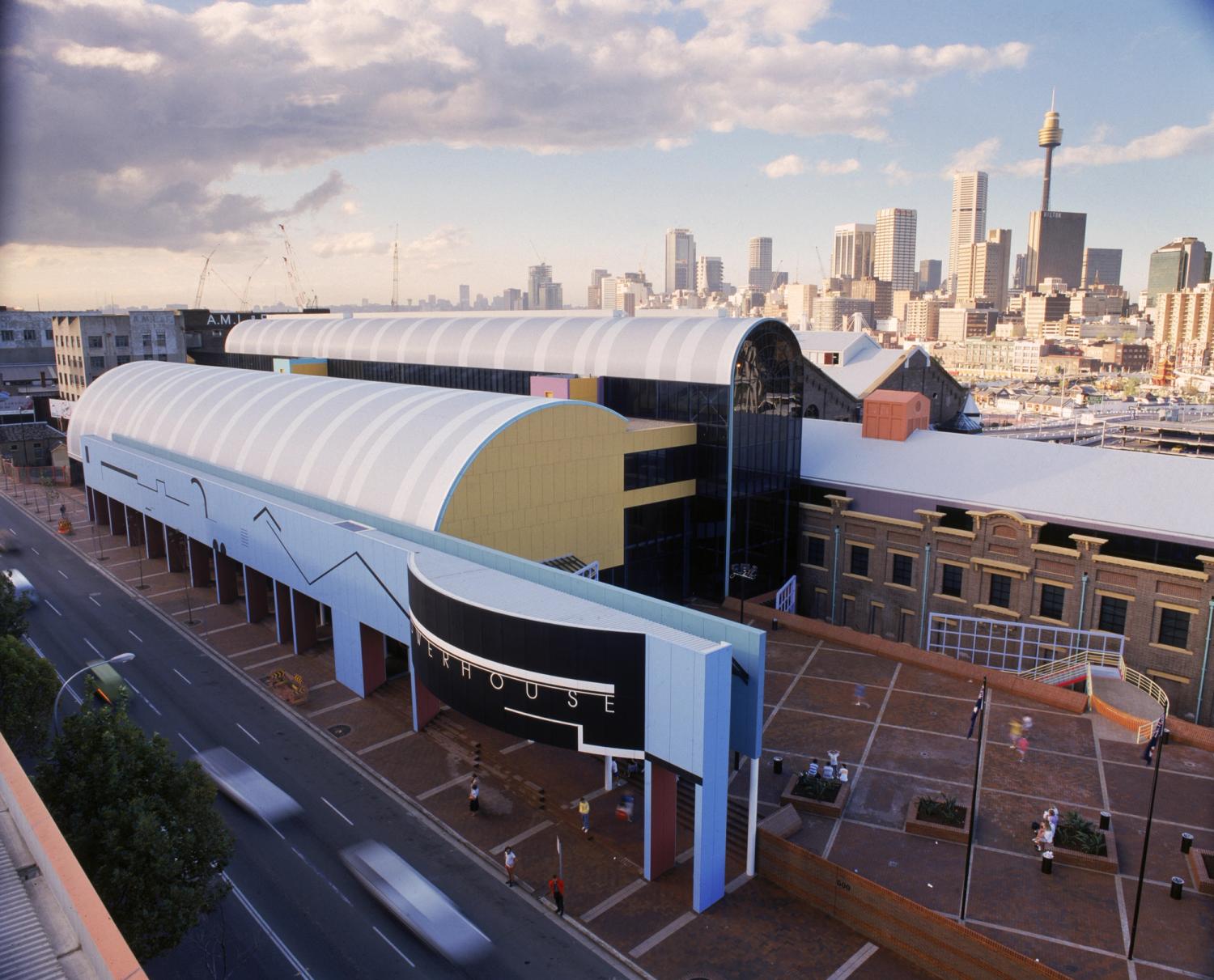
The Powerhouse is the perfect museum for ‘The 80s Are Back’. After all, the museum is itself an artefact of the 80s, one of Sydney’s major statements of ‘the design decade’. Its interior and exhibition design displayed a level of sophistication and consistency unprecedented in an Australian museum.

Style exhibition 1

Collection, Powerhouse Museum.

‘The 80s Are Back’ includes some pieces which were on display when the PHM opened in 1988. These include the Carlton room divider/bookcase designed by Ettore Sottsass, founder of the Memphis design collective.

The photo shows this signature statement of postmodernism in the ‘Style’ exhibition in 1988, together with Sottsass’ Treetops floor lamp, which also features in ‘The 80s Are Back’. The ‘Style’ fit out was designed by Iain Halliday, then barely out of design school, one of several young designers whose reputation was boosted by work at the new museum. As part of Burley Katon Halliday, he is now one of Sydney’s design eminences, with a portfolio which expanded from interiors to complete buildings.

Also on display in ‘The 80s Are Back’ is a credenza (or sideboard) designed by Halliday for the PHM boardroom on the top floor of the museum building.

00576091

Collection, Powerhouse Museum.

obj 2009 39 025

Collection, Powerhouse Museum.

Unlike the Memphis works, this piece of 80s flamboyance has not been seen before in public. Together with a large meeting table, the credenza was intended to complement the decorative boardroom interior designed by project architect Lionel Glendenning. As well as being a talking point, the table was to be democratic, not creating any sense of hierarchy among those meeting around it.

The furniture was typical of 1980s design in being expressive and sculptural as well as highly crafted, and combining a range of exotic and prosaic materials. These included silver ash, birch, Macassa ebony veneer and marble as well as aluminium, steel and brass. However when installed in the boardroom, the commissioned furniture quickly became a source of controversy. The surface of the table was damaged at its first meeting, and the Knoll chairs purchased for the boardroom did not interact well with the table.

photo

Collection, Powerhouse Museum.

More generally, the size (more than six metres long) of the table made it impractical to move, meaning that the boardroom could not be used for larger functions or meetings.

By August 1988 a Liberal government had been elected in NSW,new trustees had been appointed to the Museum board andTerence Measham had been appointed as Acting Director. According to Measham,

the Board of Trustees loathed the Halliday board room table with a passion and immediately ordered me to get rid of it…The Trustees were unanimous. Not even the art/design Trustees defended the table… I was a very new Director and dragged my feet over this matter but at the next meeting they were incensed at my falure to carry out their wishes and made it clear that the matter was urgent and not negotiable. As a newly appointed Director I was aware that my terms of employment required me to carry out their orders. Publicly, I wore the blame…

[Communication with the acquiring curator, December 2009]

After a few months use, the furniture was disassembled and placed in storage. Plans were made to display it in the ‘Style’ exhibition, but curators refused to acquire it into the collection, hoping that it would be returned to its original purpose.

The furniture’s banishment resulted not from a failure of its design, which created the ‘jewel’ furniture sought by the brief. Similarly, the museum’s management was facing the challenges posed by the first major multi-disciplinary museum launched in Australia for decades, a status which tested the new building against a new set of practicalities including the need to gain revenue from hire of theatres and other spaces. The boardroom was not the only space to undergo change as a result.

Over two decades, the boardroom furniture gained something of a mythic reputation, an artefact of the heady 80s when the museum was a pioneer of the possibilities of museums and a high profile promoter and product of the best of Australian design. In 2009 I decided to acquire the furniture into the collection, and hopefully to display it in ‘The 80s Are Back’.

No photos could be found of the furniture during its stay in the boardroom. Its reassembly at Castle Hill store produced some surprises notably that the credenza was a larger piece than realised. The lower section consists of two refrigerated spaces beneath a row of drawers, but it was found that the credenza also featured an upper section containing a set of glass shelves within a curved Craftwood wall and intricate folding doors.

00576102

Collection, Powerhouse Museum.

The brass mesh enclosure creates the impression of a postmodern Kalgoorlie safe.

Beautifully made, controversial and striking, the boardroom credenza is back.

Prince William in Sydney

Collection, Powerhouse Museum.

The Powerhouse Museum is no stranger to royalty. In 2007-2008 we hosted the major exhibition Diana: a celebration and we have welcomed many royal visitors and heads of state through our doors, including: Queen Beatrix of the Netherlands and HRH Prince Claus, King Juan Carlos and Queen Sophia of Spain, King Carl XVI Gustaf and Queen Silvia of Sweden, Pope John Paul II, Crown Prince Frederik and Princess Mary of Denmark and…Prince William? Well, no, unfortunately we can’t claim that one yet. But, I hear the Prince has the afternoon at leisure, so there’s still a chance!

As Prince William was a product of the 80s, and the Museum has gone Back to the 80s itself, I thought I’d look at one object in the collection from this decade currently on display that is particularly appropriate to his visit. It is ‘The Royal Family pop-up book’ published in 1984 to celebrate and record “one of the most exciting periods in the lives of the Royal Family”.

Collection, Powerhouse Museum.

As described on the blurb of the book, it contains six ‘moveable’ scenes of the family, illustrated by Roger Payne and narrated by Patrick Montague-Smith with paper engineering by Vic Duppa-Whyte. The book was donated to the Museum in 1994.

Collection, Powerhouse Museum.

The main scene of interest to us in light of Prince William’s visit is ‘The Royal Crawlabout’. It shows the baby Prince on his first visit to New Zealand with Charles and Diana, not long after their tour of Australia (the reverse schedule of Prince William’s current travel plans, which also happens to be his first return visit since the above image was captured!). The text reads:

Following their tour of Australia, the Prince and Princess of Wales flew on to New Zealand, arriving in Auckland on 17 April 1983. Here they received a warm welcome, despite the cold and drizzle. The one member of the Royal Family the people most wanted to see was Prince William, then aged almost ten months. On one of the few fine mornings during their stay, an important engagement was carried out on the lawns of Government House, Auckland: as the Prince said, this was the “Royal Crawlabout”. Accordingly, numerous journalists, photographers and television teams arrived to take up their positions, almost as the Prince warned them that there was no guarantee that William would perform! But no sooner had he been sat on the large floral carpet that he started to crawl in all directions!

Collection, Powerhouse Museum.

The other scenes in the book include a family barbeque at Balmoral Castle (below), the wedding of Prince Charles and Lady Diana Spencer (above), the Prince and Princess of Wales at Ayres Rock, the Prince and Princess of Wales at Fort Edmonton, Canada and Queen Elizabeth II opening Parliament.

Each illustration ‘pops up’ from the page and contains moving sections operated by pull-tabs.

Collection, Powerhouse Museum.

The book is currently on display in the 80s exhibition in the fashion and subcultures section, as Princess Diana and her wedding dress, in particular, had a huge impact on the fashion of the era (many brides couldn’t wait to emulate the puffy sleeves and big shoulders!).

So, Prince William – if you’re looking for things to do this afternoon, the Museum is waiting!

What were they thinking??? Vegemite iSnack 2.0

IMG_0974

Collection, Powerhouse Museum.

We couldn’t let 2009 disappear without acquiring a jar of iSnack 2.0, the shortest-lived Vegemite product in history!

Kraft released this new cheese-based Vegemite spread in July 2009 with a label inviting people to name it. Forty eight thousand Vegemite fans responded and, in late September, the winning entry hit the shelves: iSnack 2.0.

The Australian people were not amused. They made their opinions very clear. An avalanche of protest descended upon newspapers, blog sites, Youtube and talk back radio. Anger, indignation and humour rallied to the defence of our favourite sticky black stuff …and some of it was nothing short of hilarious. Do a Google search on iSnack 2.0 to catch a snippet.

Days later, as a result of the outcry, Kraft set up an internet voting site with a range of alternative names. Vegemite Cheesybite was a clear favourite, so you’ll see it soon in a store near you. Vegemite was renamed once before in 1928 when the company tried to call it Parwill. Not surprisingly, it didn’t catch on either.

00x11289

Collection, Powerhouse Museum.

The new jar will join the Museum’s fabulous collection of Vegemite containers. We have an original lighthouse-shaped jar from1923 when Vegemite was first made, and ‘opal’ glass jars from 1928 to the 1950s. Reusable plastic tumblers made an appearance in the 1940s, followed by clear glass jars in the 1960s and 70s. The 1980s ushered in glass jars with plastic lids, and the 1990s saw the introduction of the plastic tube, no doubt for those who can’t bear to leave their Vegemite at home.

We’re still looking for one of the porcelain jars that were used in 1926. If you’re clearing out your cupboards or the shed over the holidays and come across one of them we’d love to hear from you.

Sandra McEwen
Principal curator
Biosciences & Built Environment